
Meeting Preparation: Why Meetings Fail Before They Start

On this page
- Why do meetings fail before they even start?
- The three most common preparation mistakes
- What unprepared meetings really cost
- What belongs in a good meeting agenda?
- The must-have elements of every agenda
- How detailed does an agenda need to be?
- When can you skip an agenda?
- How do you choose the right participants?
- The two-pizza rule and its limits
- Decision-makers, contributors, informed parties
- How much lead time does a meeting need?
- What happens when the invitation comes too late
- How to determine the right lead time
- Planning recurring meetings on a fixed rhythm
- What role does the moderator play before the meeting?
- Tasks before the first word
- Tech check for online and hybrid meetings
- How to improve your meeting preparation step by step
- What you can do right away
- Frequently asked questions about meeting preparation
- Sources
Most meetings do not fail because of bad moderation or a lack of participant engagement. They fail because meeting preparation is missing. According to the Flowtrace State of Meetings Report (Flowtrace, 2025), 64 percent of all recurring meetings have no structured agenda. Participants show up without a clear goal, discuss without reaching a result, and schedule a follow-up meeting that repeats the same problem.
The consequence is measurable. German employees lose an average of 7 hours per week to unproductive meetings (Asana, 2024). For managers, it is 12 hours.
Why do meetings fail before they even start?
Meetings rarely fail because of bad moderation. According to the Flowtrace State of Meetings Report (Flowtrace, 2025), 67 percent of all meetings are considered unproductive. The cause almost always lies in the minutes and hours before the meeting.
The three most common preparation mistakes
One central mistake is a missing meeting agenda. The HR WORKS meeting efficiency study (HR WORKS, 2025, more than 1,000 respondents) shows that 25 percent of respondents say their meetings take place with no clear agenda at all. Participants show up unprepared, discussions run without direction, and no tangible result emerges at the end. The second mistake is inviting the wrong participants. Inviting too many people extends discussions and dilutes decisions. Inviting too few means results have to be confirmed afterward, which triggers additional meetings.
The third mistake concerns the timing of the invitation. When participants have no chance to prepare, they bring neither ideas nor a basis for decisions. How is someone supposed to make an informed contribution when they only learn about the meeting the evening before?
What unprepared meetings really cost
The financial consequences are significant. According to the Asana State of Work Innovation study (Asana, 2024), employees in Germany lose an average of 7 hours per week to unproductive meetings. For managers, it is 12 hours. Multiplied by the average hourly rate, that adds up to a four-figure amount per person and month that never shows up in any cost calculation. And the indirect costs are not even included yet. 38 percent of employees say that poorly planned meetings lead to overtime, according to the HR WORKS study (HR WORKS, 2025). The combination of wasted working time and extra hours after work makes unprepared meetings one of the most expensive productivity problems in daily work.
What belongs in a good meeting agenda?
Anyone who skips the agenda gives up the simplest lever of meeting preparation. A few elements decide whether a meeting runs productively or goes in circles.
The must-have elements of every agenda
A complete meeting agenda starts with a concrete goal. What should be decided, clarified, or resolved by the end of the meeting? Without a goal, there is no way to judge whether the meeting succeeded. The second element is agenda items with a fixed time slot. Planning 30 minutes for three topics also signals that deeper discussion has to happen elsewhere. Third, every participant should have a clear task tied to an agenda item, so that no one sits passively in the meeting.
Fourth, the agenda points to preparatory materials. Reports, figures, or drafts should reach all participants in advance so the meeting does not begin with reading documents. Fifth, the agenda defines the expected outcome for each item. Should a decision be made, a status aligned, or a brainstorming session held? Anyone who consistently applies these five elements gives every meeting a clear direction.
How detailed does an agenda need to be?
With a meeting agenda, less is more, as long as the five elements are present. An agenda with three sentences per item is enough. What matters is not length but clarity. Can participants answer, after reading it, why the meeting is happening and what is expected of them? Then the agenda is sufficient. Many meeting leads spend too much time wording the agenda and too little time asking whether the right items are even on it.
When can you skip an agenda?
For informal check-ins with fewer than three people and under 15 minutes, a formal agenda can be skipped. In all other cases, the effort pays off. Even a meeting agenda with just three lines gives a meeting a direction it would otherwise lack.
How do you choose the right participants?
Participant selection decides whether a meeting reaches a result in 20 minutes or goes in circles for 60. According to the Calendly State of Meetings Report (Calendly, 2024), 40 percent of employees say their least productive meetings lack notes and clear tasks. Too many participants make this problem worse because responsibility gets diluted and decisions get postponed. The article on meeting follow-up shows how to turn results into binding tasks.
The two-pizza rule and its limits
Amazon coined the rule that no team should be so large that two pizzas cannot feed it, ideally fewer than 10 people (AWS Executive Insights). Research supports this rule of thumb. Dr. Steven Rogelberg of the University of North Carolina at Charlotte found that almost a third of all meetings are rated as unnecessary by their own participants (SpeakWise, 2026). In many cases this is not about the topic, but about people being invited who could not make an active contribution.
Decision-makers, contributors, informed parties
More useful than a rigid headcount is distinguishing by role. Who needs to make the decision? That person is essential. Who provides subject-matter input? Those people belong in the room too. Who only wants to be informed? Those people get the meeting minutes but do not sit in on the meeting. With a meeting minutes template, those minutes are written quickly. Ask yourself for every invitation whether the person will actively contribute to the result. If the answer is "no," remove the name and send a summary after the meeting instead. This simple filter noticeably shrinks many invitation lists without losing relevant perspectives.
How much lead time does a meeting need?
At least 24 hours, ideally 48. The Flowtrace report (Flowtrace, 2025) shows that 35 percent of all meeting invitations are sent less than a day before the meeting. The Calendly State of Meetings Report confirms the problem from the other side. 37 percent of respondents receive neither pre-reading materials nor an agenda before external meetings (Calendly, 2024). Without materials, participants cannot prepare, no matter how much lead time the invitation gives them.
What happens when the invitation comes too late
Short-notice invitations signal to participants that their preparation apparently does not matter. The consequence is predictable. According to a survey by The Muse, 92 percent of employees admit to doing other tasks during meetings (SpeakWise, 2026). Without preparation time, participants have no grounding in the topic, and multitasking becomes the logical consequence.
The solution is to send invitations with an agenda and materials at least 48 hours in advance. That gives participants enough time to read documents, ask questions, and prepare their own contributions. Whether you are planning a Zoom meeting or a Teams meeting, the timing of the invitation remains a central lever of meeting preparation.
How to determine the right lead time
Not every meeting needs the same lead time. A short status check among three familiar colleagues works with 24 hours of lead time. A workshop with external participants and preparatory materials needs a week. Base it on the complexity of the decision, not the length of the meeting. The HR WORKS meeting efficiency study (HR WORKS/ingenieur.de, 2025, n=1,040) arrives at smaller figures with a different methodology. There, German employees spend an average of 4.7 hours per week in meetings and consider 3.2 of those hours wasted. The better the lead time is planned, the fewer of those hours go to repeat questions and follow-ups.
Planning recurring meetings on a fixed rhythm
For regular meetings such as weekly updates, sprint reviews, or team check-ins, a fixed calendar slot pays off. Zoom and Teams both offer recurring meeting series for this. If the meeting happens every Tuesday at 10 a.m., scheduling disappears completely and everyone can plan around it. What matters is that the goal stays clearly defined every time. A "weekly update" always has the same format, for example going through open tasks, identifying blockers, and setting priorities for the coming week. Combining a fixed time slot with a consistent structure significantly reduces preparation effort, because everyone knows what is expected and what information to bring.
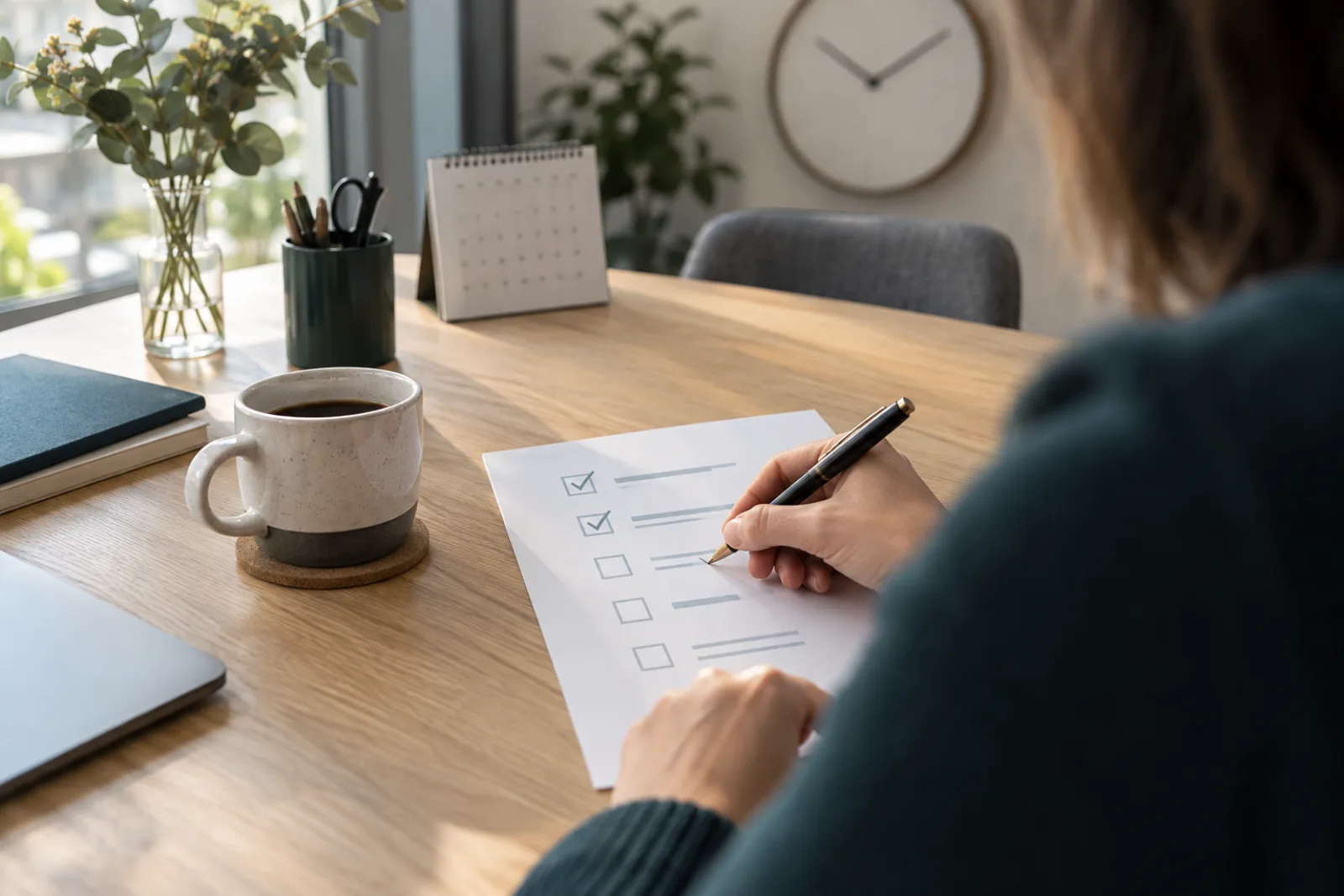
What role does the moderator play before the meeting?
The moderator's role does not start with the first spoken word, but with preparation. Since early 2020, weekly meeting time among Teams users has risen by 252 percent, according to the Microsoft Work Trend Index (Microsoft, 2022). It matters all the more that someone actively manages the quality of those hours before the meeting begins. The article on meeting management describes what the moderator does during the meeting itself.
Tasks before the first word
The moderator checks in advance whether the agenda is realistic. Do three topics fit into 30 minutes? Are the right people invited? Are all materials ready, including a meeting minutes template for the results? The moderator also clarifies the decision method in advance. Is the decision made by consensus, by majority, or does one person decide in the end? If this question only comes up during the meeting, it costs valuable minutes and often causes frustration, because participants bring different expectations. A moderator who clarifies these points in advance prevents the most common friction during the meeting itself.
Tech check for online and hybrid meetings
According to the Owl Labs State of Hybrid Work Report (Owl Labs, 2024), 86 percent of employees now have online or hybrid meetings. Does screen sharing work? Is the conference room cabled correctly? Does every participant have access to the link? Before an online meeting, also check the waiting room, breakout rooms, and where the recording will be stored. Technical problems delay the start of many meetings. Five minutes of tech checks before the meeting save every participant from waiting during the meeting itself. Anyone who also starts a tool like Jexity Meet or the platform's built-in recording feature in advance makes sure the meeting is documented from the first minute.
How to improve your meeting preparation step by step
Meetings do not become productive overnight, but a single consistently prepared meeting per week already sets a standard. The HR WORKS study (HR WORKS, 2025) shows that almost half of employees consider their meetings too long. Good meeting preparation shortens meetings, because focused meetings need less time.
What you can do right away
Start with the simplest lever. Add the agenda directly to the invitation for your next meeting, even if it is only three lines long. With this step alone, all participants know what it is about and what is expected of them.
In the next step, narrow the participant list down to those who actively contribute to the result. And in the third step, send the invitation 48 hours in advance instead of the evening before. Each of these three measures takes less than ten minutes but fundamentally changes the quality of your meetings. That applies in the meeting room just as much as online, for example when you plan a Teams meeting. The agenda usually has the biggest effect, because it clarifies goal, structure, and expectations all at once.
Frequently asked questions about meeting preparation
How long should meeting preparation take?
Preparation time depends on complexity. Simple alignment calls need far less preparation than workshops with multiple decision points. Schedule preparation firmly into your calendar instead of squeezing it in between other tasks. The Calendly State of Meetings Report (Calendly, 2024) shows that 37 percent of respondents receive neither materials nor an agenda before external meetings, which makes solid preparation impossible.
Does every meeting need an agenda?
Almost every one. Exceptions are informal check-ins with fewer than three people and under 15 minutes. For all other meetings, three lines of meeting agenda are often enough so everyone knows what should be decided by the end.
How many participants are ideal?
Five to eight people work well for most decision-making meetings. Each additional person leaves less speaking time for everyone else. Distinguish between people who actively contribute and those who only need to be informed. The latter receive the meeting minutes.
What should you do if the invitation comes at short notice?
Ask whoever sent the invitation about the goal of the meeting and any materials you should read beforehand. If both are missing, suggest postponing the meeting by 24 hours. A prepared 20-minute meeting delivers more than an unprepared 60-minute one.
What tools help with meeting preparation?
Calendar apps offer agenda fields directly in the invitation. For documentation during the meeting, AI transcription tools like Jexity Meet help by automatically writing down what is said. A meeting minutes template then gives the result a fixed structure. Project management tools are useful for collecting topics in advance and assigning tasks after the meeting.
Sources(10)
- flowtrace.coFlowtrace: State of Meetings Report (2025)
- asana.comAsana: State of Work Innovation Report Germany (2024)
- presseportal.deAsana: press release on meetings as a source of stress (2024)
- saatkorn.comHR WORKS: meeting efficiency study (2025, more than 1,000 respondents)
- ingenieur.deingenieur.de: online meetings as time sink or key to success (2025, HR WORKS study, n=1,040)
- microsoft.comMicrosoft: Work Trend Index, Great Expectations (2022)
- calendly.comCalendly: State of Meetings Report (2024)
- speakwiseapp.comSpeakWise: Unnecessary Meetings Statistics (2026)
- aws.amazon.comAWS Executive Insights: The Amazon Two-Pizza Team (foundational article)
- owllabs.comOwl Labs: State of Hybrid Work Report (2024)
This article was created with AI assistance and editorially reviewed. Images are AI-generated.
Keep reading

Meeting Follow-up: Turning Results Into Action
Every week, thousands of meetings end without clear ownership. The result is forgotten tasks, duplicated work, and follow-up meetings that repeat the same topic. This article shows the full path from a meeting outcome to a completed action.
12 min read
Effective Meetings: From the Meeting Agenda to the Result
An employee in Germany attends around 65 meetings a month and considers half of them unnecessary. This guide shows which meetings are worth holding, how a meeting agenda should be built, who should attend and how to tell whether things are improving.
22 min read
Spotting Inefficient Meetings and Avoiding the Biggest Mistakes
Bad meetings are always the other person's fault, or so the thinking goes. It is the most common myth in meeting culture, and the data clearly disproves it. This article walks through the points where inefficient meetings take root, from the invitation to the minutes, and names the fix for each one.
16 min readTry it on your next meeting
Record or import one meeting and see the minutes it produces. No account and no credit card.