
Spotting Inefficient Meetings and Avoiding the Biggest Mistakes
On this page
- Why does almost everyone think their own meetings go well?
- Half of all participants work on something else
- Why criticism never reaches the person who sent the invitation
- Your own appointments feel necessary, other people's do not
- What is usually missing from the invitation?
- Why a topic is not yet a goal
- How to phrase the goal in the invitation
- Who belongs on the attendee list?
- What too many people in the room do
- Whom to invite and whom to just inform
- When moderation and decision-making sit with the same person
- Whoever talks a lot appears competent
- What evenly distributed talk time does
- How to separate the roles
- How tightly can the calendar be scheduled?
- Attention drops before exhaustion does
- Why video calls are additionally draining
- Buffers and best practices for online meetings
- The recurring meeting nobody checks anymore
- How to spot a dispensable meeting
- Four ways to get rid of unnecessary meetings
- Who is responsible for the minutes?
- Memory is not documentation
- What automatic minutes change about this
- Which meeting rules prevent inefficient meetings?
- What unproductive remarks cost
- Which meeting tips actually stick in everyday work
- Frequently asked questions
- Sources
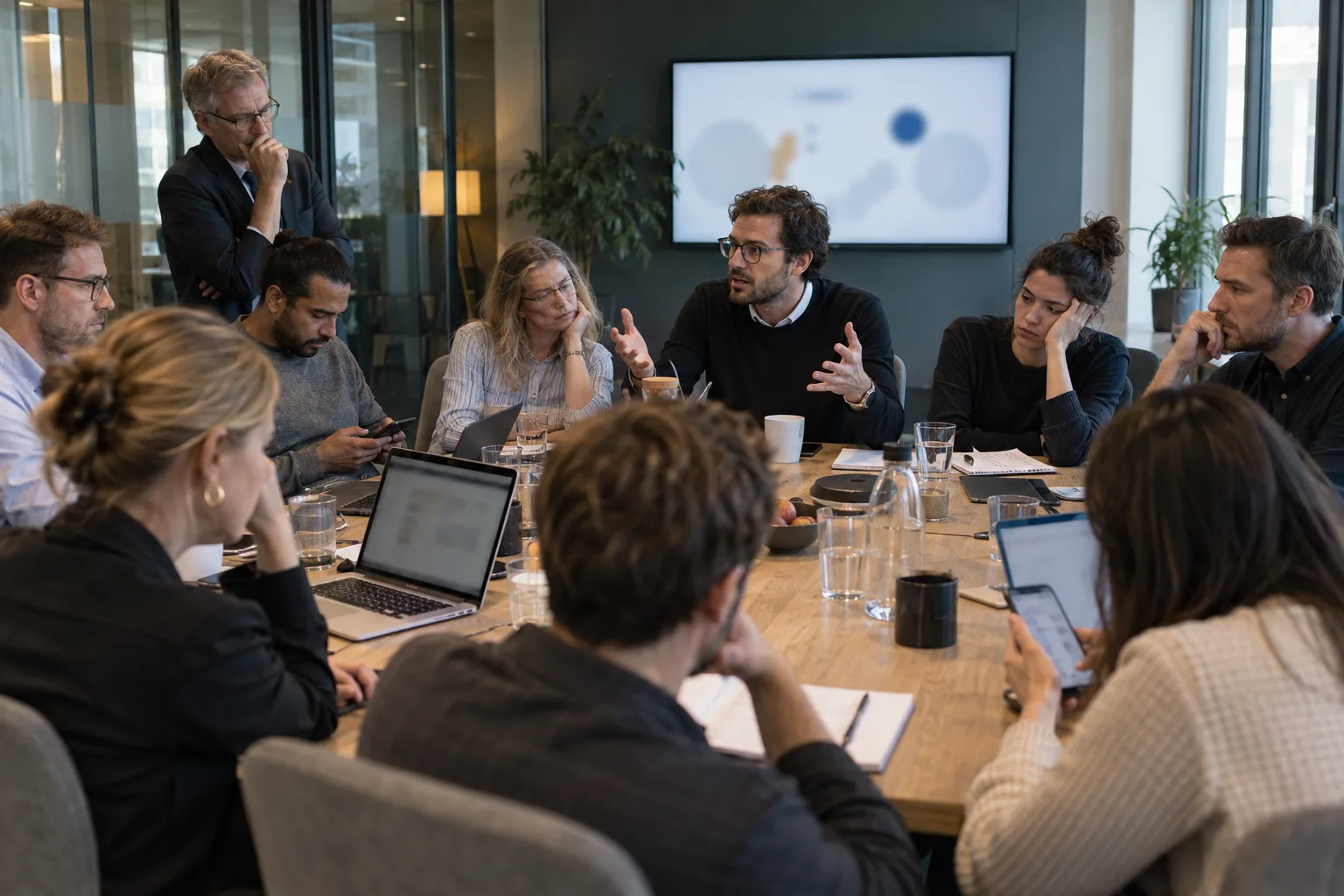
There is a belief that holds in almost every company and is wrong all the same. Bad meetings, so the assumption goes, are always run by other people. Meeting researcher Steven Rogelberg describes a perception effect that hits everyone who schedules appointments. People who run a meeting find it harder than everyone else in the room to judge its quality (shrm.org). How large the gap between self-image and reality really is becomes clear on the other side of the screen. Half of all employees handle other work tasks during online meetings (presseportal.de). The meeting you consider focused is running in the background for every second person present. Inefficient meetings therefore rarely get noticed by the person who scheduled them, and common online meeting best practices do not fix this blind spot either.
Why does almost everyone think their own meetings go well?
Because a meeting looks different from the front than from the side. Whoever sends the invitation knows the goal, steers the flow, and can end the meeting at any time, and this position colors the assessment regardless of role or hierarchy. Economically, this matters, because organizations spend 7 to 15 percent of their personnel budget on meetings (shrm.org). Inefficient meetings consume this budget without producing a decision.
Half of all participants work on something else
The survey of 1,006 employees in Germany from August 2020 shows even more. Alongside the 50 percent who handle other work tasks in parallel, 12 percent admit to having already fallen asleep during a video call (presseportal.de). Among 18- to 34-year-olds, 61 percent answer private emails or browse the web on the side, compared with 27 percent among those over 55.
Why criticism never reaches the person who sent the invitation
Criticism of a meeting always also hits the person who called it, which is why it stays unspoken. Feedback would help. In a survey by SurveyMonkey and Zoom, 70 percent of respondents believe feedback would make their meetings better, but only 54 percent were asked for it (surveymonkey.com). Without that feedback, the self-image goes unchallenged.
Your own appointments feel necessary, other people's do not
The burden is also perceived differently. In a study by Harvard Business School involving more than 180 managers, 65 percent said meetings kept them from their own work (arbeits-abc.de). So whoever schedules appointments sits in just as many of them and finds them just as disruptive. The only difference lies in the judgment. The mistakes behind this almost never happen during the conversation itself. They sit before and after it, in the invitation, the attendee list, the moderation, the calendar, the recurring series, and the minutes. The following sections work through these stations one by one, offer concrete meeting tips, and show which meeting rules actually help.
What is usually missing from the invitation?
Usually the goal. Inefficient meetings often fail right here, because an appointment without a defined outcome inevitably ends without one. In a Europe-wide survey of 8,044 office employees, including 1,001 in Germany, 55 percent already said in 2018 that their meetings mostly did not lead to clear results (datev-magazin.de). A German survey of 1,040 employees fits the same picture, with 31 percent citing a lack of concrete decisions (betriebsratspraxis24.de).
Why a topic is not yet a goal
"Q3 project status" is a topic. "We decide whether module B gets postponed" is a goal. The first appointment can run indefinitely and still lead nowhere, while the second has a defined endpoint. Check your next invitation against this. If it names a noun, the goal is missing.
How to phrase the goal in the invitation
In the same German survey, 24 percent complain that their meetings never or rarely have a clear agenda (hrworks.de). Whoever only formulates the goal once everyone is already in the room wastes everyone's preparation time and, at the same time, takes away their chance to decline for a good reason. The group grows for the same reason it stays unproductive. How strongly a meeting's outcome depends on the invitation, and which meeting tips already help at the preparation stage, is covered in the article on meeting preparation.
Who belongs on the attendee list?
As few people as possible. One line further down in the same invitation waits the next mistake. Too many attendees and the wrong attendees are each named by 30 percent of respondents as a reason for inefficient meetings (datev-magazin.de), and 26 percent doubt that their own presence is necessary (hrworks.de).
What too many people in the room do
French agricultural engineer Maximilien Ringelmann had groups of different sizes pull on a rope. Three people together still reached 85 percent of the expected performance, eight people only 49 percent (karrierebibel.de). Each individual therefore pulled roughly half as hard as they would alone. In meetings, the same pattern shows up as passivity, known in the field as social loafing, the tendency to hide in a large group and leave the effort to others. On top of that comes an imbalance in the conversation itself, described by the magazine Neue Narrative. Extroverted colleagues in particular, along with people in higher positions of power, are the ones who talk, interrupt others, or change direction. For joint decisions, the magazine recommends no more than seven people (neuenarrative.de). Established meeting rules generally name a group size of five to eight people (karrierebibel.de). As a rule of thumb, decision-making groups should land at five to seven people.
Whom to invite and whom to just inform
Separate these consistently when inviting people. Whoever needs to contribute something should attend. Whoever just needs to be informed should get the outcome. This separation only holds if the outcome reliably materializes; otherwise everyone returns to the meeting just to be safe, because attendance remains the only reliable source of information.
When moderation and decision-making sit with the same person
Moderating and having a substantive say are two different jobs, and whoever takes on both at once usually does only one of them well. In many organizations, moderation falls to the manager simply because they called the meeting, not because the role was deliberately assigned. Whoever moderates while also holding a substantive position more easily gives themselves the floor and tends to moderate other people's contributions away (neuenarrative.de). The person is not the problem; the mixing of roles is.
Whoever talks a lot appears competent
Research calls this the babble effect. Neil MacLaren and Francis Yammarino of Binghamton University showed in 2020 that talk time correlates with perceived leadership competence, independent of intelligence, personality, and gender (arbeits-abc.de). What matters is how often someone speaks up, not the quality of what they say. A replication with 38 teams and more than 190 participants confirmed the effect again in 2025.
What evenly distributed talk time does
A study of 192 teams found that groups with evenly distributed talk time showed higher collective intelligence than groups dominated by a few voices (arbeits-abc.de). The distribution of talk time is therefore not a matter of politeness but a quality marker of the decision that ultimately comes out of the room.
How to separate the roles
The manager does not have to give up moderation, but should visibly separate it from their own position. Whoever moderates keeps the floor open for every voice and brings in their own position last, so it does not act as an anchor. For recurring team meetings, the simplest solution is a rotating moderation in a fixed order. It distributes responsibility and prevents the same voice from always setting the direction. How this role plays out in practice is covered in the article on meeting management.
How tightly can the calendar be scheduled?
Not back to back. When meetings sit one after another without a break, the stress adds up measurably. Zoom fatigue makes this worse for video calls, and a tightly packed calendar produces inefficient meetings even when the preparation is solid. Microsoft's Human Factors Lab had 14 people complete four half-hour meetings on two separate days, once directly back to back and once with ten-minute breaks in between. Without breaks, beta wave activity in the brain rose from meeting to meeting; with breaks, it stayed stable (personalwirtschaft.de). Beta waves are a marker of tension measurable by EEG. If they keep rising across a series of meetings, stress builds up that never gets a chance to drain in between.
Attention drops before exhaustion does
The same measurement captured frontal alpha asymmetry, a value indicating whether someone is engaging with a task or mentally withdrawing from it. With breaks it turned out positive, without breaks negative (personalwirtschaft.de). The fourth meeting in a row is therefore more exhausting, and its content lands less well. Whoever schedules important decisions at the end of a block decides with the worst attention available.
Why video calls are additionally draining
Video calls add a second burden. Stanford University's Virtual Human Interaction Lab, led by Jeremy Bailenson, traces zoom fatigue back to nonverbal overload (i-gb.de). The idea is that a video call places four extra tasks on the brain that do not arise in a meeting room. Eye contact is the first. In a room, people rarely look at you directly for more than a few seconds; on a call, every face looks straight at you continuously, and at a size otherwise reserved for very close conversations. Self-monitoring adds to this, because you see yourself the whole time. The tight framing forces a rigid posture, since any movement takes you out of frame. And because facial expressions and body language only come through in fragments, the brain has to fill in the rest. These four tasks run in parallel to the content, which is why one hour of video conferencing exhausts more than one hour in a room, and without targeted online meeting best practices the strain adds up over the day.
Buffers and best practices for online meetings
Schedule appointments for 25 or 50 minutes instead of the full 30 or 60. The break then happens automatically, without anyone having to negotiate it, and the next meeting starts on time. Established online meeting best practices also include two settings that cost nothing and reduce zoom fatigue immediately. Turn off self-view and skip a blanket camera-on rule in longer sessions. How strong the strain is in a team can be measured with the Zoom Exhaustion and Fatigue Scale, which comes from the same research and is available in German.
The recurring meeting nobody checks anymore
The weekly meeting is the only cost item in a company that keeps running without ever being reviewed again, and this exact routine quietly causes inefficient meetings. Employees in Germany attend an average of 4.4 meetings per week and spend 4.7 hours on them. From employees' own perspective, 68 percent of these meetings could be used more productively, equivalent to 3.2 hours per week (betriebsratspraxis24.de).
How to spot a dispensable meeting
Two questions are enough to check. What decision has been made in this meeting in the last four weeks, and what would happen if it were skipped once. If the first question goes unanswered and the second has no consequences, the meeting is no longer a meeting but a habit. A more radical approach flips the burden of proof entirely. Every recurring meeting without a recognizable purpose gets removed from the calendar, and each one may only return once someone justifies its value (neuenarrative.de). It is no longer cancellation that needs a justification, but continuation.
Four ways to get rid of unnecessary meetings
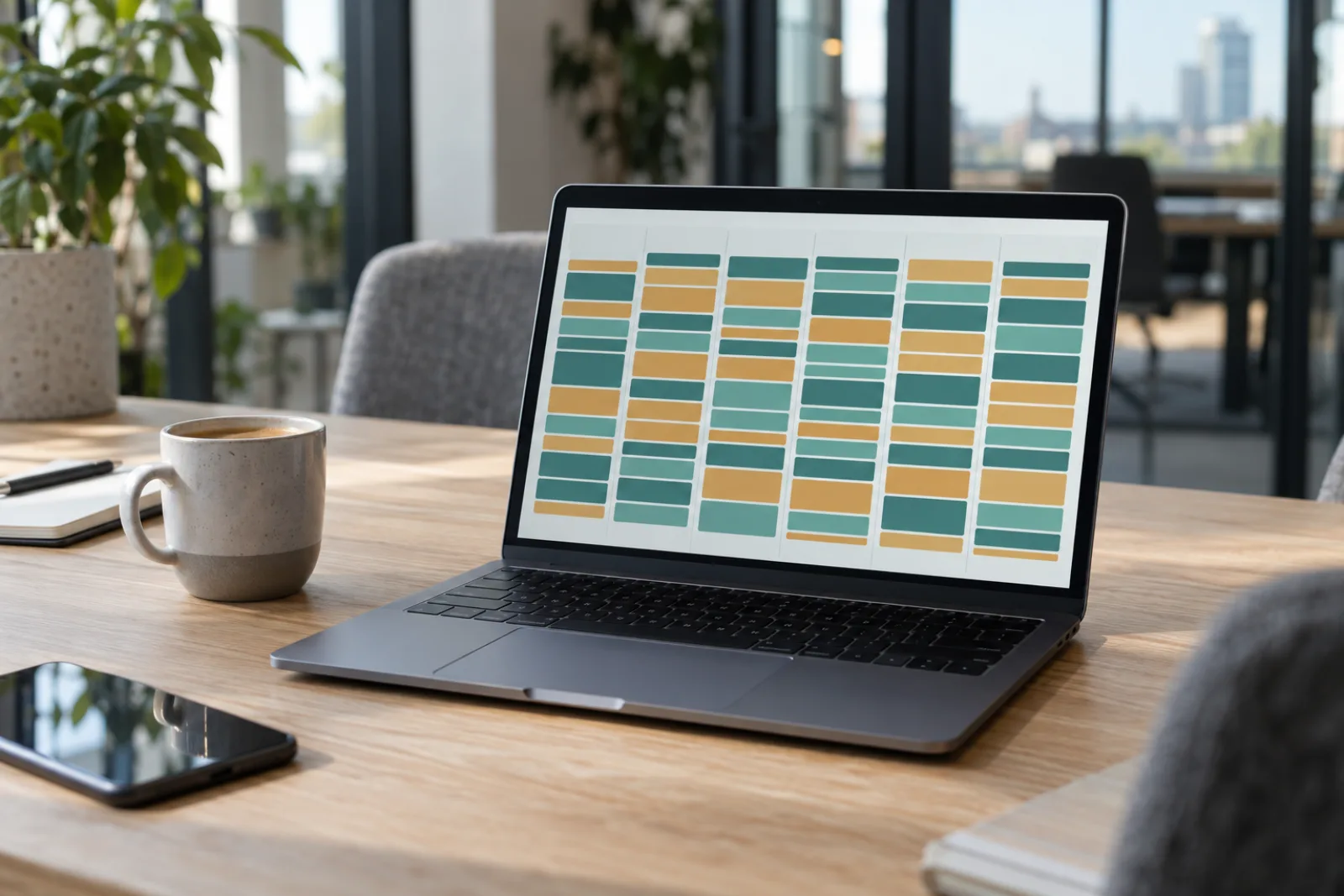
Cancelling is only one of four options. Keep and sharpen fits when the meeting is needed but the goal and agenda are missing. Shorten and tighten the attendee list fits when it runs too long or too many people sit in. Replace with async fits status rounds without a decision, since a short written update reaches the same people without blocking their calendar. Cancel is for anything that only continues out of habit. Meeting-free days or fixed focus blocks help as well, because they create uninterrupted working time instead of just moving cancelled meetings elsewhere. These meeting tips only work long term if the team repeats the review regularly. How the four methods work in detail is covered in the article on reducing unnecessary meetings, and the financial side in the article on meeting costs.
Who is responsible for the minutes?
In most meetings, nobody, and that is the final mistake. As long as no name is attached, the minutes either never get written or end up stuck with whoever takes the most notes anyway. Meetings are where processes get aligned, opinions exchanged, ideas generated, decisions made, and action plans forged, as work and organizational psychology summarizes it (psy.uni-hamburg.de). The last two points only survive the meeting if someone writes them down. That is why responsibility for the minutes belongs in the invitation, not in the first few minutes of the meeting, and it should rotate.
Memory is not documentation
A week later, the people involved walk away with different versions of the same conversation, and whoever argues most forcefully wins. An outcome that is written down nowhere counts, in case of doubt, as never agreed. Which mistakes happen most often in the writing itself is covered in a separate article on mistakes in meeting minutes.
What automatic minutes change about this
Where nobody should have to take notes continuously, software like Jexity Meet takes over this part and turns the recording into a transcript and a draft of the minutes. Three things change. The double workload disappears, because nobody has to listen and type at the same time anymore, which otherwise often pulls the strongest contributor out of the discussion. The cost of follow-up work drops, because twenty minutes of typing becomes a short review and approval step. And the results become comparable, because every set of minutes follows the same structure. When choosing a tool, the range of features matters less than where the processing happens, since for law firms, tax advisory firms, and HR departments this decides whether a tool is even an option at all. Responsibility shifts from taking notes to reviewing and approving them. The structure of good minutes is covered in the article on meeting minutes, and the path to action items in the article on meeting follow-up.
Which meeting rules prevent inefficient meetings?
Few, but binding ones. Professor Nale Lehmann-Willenbrock, who studies meetings at the University of Hamburg down to the second using video and audio analysis, names three rules for effective meetings: start and end on time, avoid monologues, and listen actively so ideas can develop (uni-hamburg.de). These meeting rules apply equally to video calls, where they also form the basis for effective online meeting best practices.
What unproductive remarks cost
Together with Simone Kauffeld, Lehmann-Willenbrock recorded 92 regular team meetings on video and categorized every remark. On one side sit constructive contributions, meaning problem analyses, proposed solutions, and concrete agreements. On the other side sit unproductive contributions, such as blanket criticism or complaints about circumstances the group cannot change. The higher the share of the second group, the less satisfied the participants, the lower the team's productivity, and the weaker the company's success, as measured again by the researchers 2.5 years later. The ratio is notable, because this negative relationship was stronger than the positive one from constructive contributions (research.vu.nl). For moderation, this means interrupting a round of complaints is worth more than soliciting one more good idea.
Which meeting tips actually stick in everyday work
Meeting tips only work if someone enforces them; otherwise they remain a list on the intranet. Close every recurring meeting by checking whether the goal was reached and who owns the next task. Ask for feedback on your own meetings twice a year, because it will not arrive on its own. The full overview of effective meetings is covered in the guide on effective meetings.
Frequently asked questions
What are the most common meeting mistakes?
One of the most common is a missing goal. 55 percent of respondents report that their meetings mostly end without a clear outcome (datev-magazin.de). Set the intended outcome down in the invitation itself, so you can check at the end whether it was reached, and you avoid inefficient meetings from the start.
How many attendees are too many?
From about eight people onward, each individual's contribution drops noticeably. In the Ringelmann experiment, eight people together reached only 49 percent of the expected performance (karrierebibel.de). For joint decisions, the group should be even smaller.
What helps against zoom fatigue?
The causes lie in nonverbal overload, especially intense eye contact and constant self-monitoring in your own camera image (i-gb.de). Turn off self-view, skip a blanket camera-on rule, and schedule breaks, since these online meeting best practices reduce zoom fatigue immediately. Just ten minutes between two meetings keeps stress markers stable (personalwirtschaft.de).
Who should take the minutes?
A named person, fixed in the invitation and rotating on a regular basis. If the role stays open, either no minutes get written or the task stays permanently stuck with the same person. Automatic minutes, for example with Jexity Meet, take the actual writing work off that person's plate. With several hours of meetings per week, the documentation decides whether that time has any lasting effect.
Can the manager moderate the meeting?
Yes, as long as they visibly separate moderation from their own position. It becomes a problem when the two blend together, because whoever moderates also controls who gets to speak. For recurring meetings, rotating moderation is the simplest solution and one of the most effective meeting rules.
Sources(16)
- shrm.orgSHRM: Fewer Meetings Can Boost Employee, Organization Productivity
- presseportal.dePresseportal: Survey on Side Activities During Video Calls (2020)
- datev-magazin.deDATEV Magazin: Study - Meetings Are Wasted Time (2018)
- betriebsratspraxis24.deBetriebsratspraxis24: Survey on Meeting Culture - Meetings Are an Unpopular Time Sink
- hrworks.deHRworks: Wasted Work Time in the Conference Room
- karrierebibel.deKarrierebibel: The Ringelmann Effect
- surveymonkey.comSurveyMonkey: Virtual Meetings (with Zoom)
- neuenarrative.deNeue Narrative: Never Have a Bad Meeting Again
- neuenarrative.deNeue Narrative: Power Dynamics in Meetings - I'm Taking Over Now
- arbeits-abc.dearbeits-abc.de: The Babble Effect - the Leadership Competence Fallacy (2020)
- arbeits-abc.dearbeits-abc.de: Meeting Madness - How Managers Suffer Under the Meeting Marathon
- personalwirtschaft.dePersonalwirtschaft: Preventing Meeting Stress
- i-gb.dei-gb.de: Zoom Fatigue at Work - Causes, Consequences, Prevention
- uni-hamburg.deUniversity of Hamburg: Newsroom - Research on Effective Meetings (2026)
- psy.uni-hamburg.deUniversity of Hamburg, Psychology: Willenbrock Abstract (2018)
- research.vu.nlVU Amsterdam Research Portal: Meetings Matter - Effects of Team Meeting Communication on Team and Organizational Success
This article was created with AI assistance and editorially reviewed. Images are AI-generated.
Keep reading

Meeting Management: Rules and Methods for More Productive Meetings
Even well-prepared meetings often fail during execution. Studies show that more than half of meeting time passes unproductively. This article presents proven methods to help you get better results starting with your next meeting.
13 min read
Effective Meetings: From the Meeting Agenda to the Result
An employee in Germany attends around 65 meetings a month and considers half of them unnecessary. This guide shows which meetings are worth holding, how a meeting agenda should be built, who should attend and how to tell whether things are improving.
22 min read
Meeting Follow-up: Turning Results Into Action
Every week, thousands of meetings end without clear ownership. The result is forgotten tasks, duplicated work, and follow-up meetings that repeat the same topic. This article shows the full path from a meeting outcome to a completed action.
12 min readTry it on your next meeting
Record or import one meeting and see the minutes it produces. No account and no credit card.