
Effective Meetings: From the Meeting Agenda to the Result
On this page
- What makes a meeting effective?
- Effective is not the same as efficient
- The consequences of bad meetings
- What is at stake
- How do you keep a meeting on track?
- Starting and ending on time
- Facilitation is a role, not a question of rank
- What belongs in a meeting agenda?
- The goal belongs in the invitation
- At most two topics per meeting
- The agenda has to exist beforehand
- Does this topic even need a meeting?
- Five criteria that justify a meeting
- When asynchronous is the better choice
- Who should attend, and who should not?
- Roles, not an audience
- How do you record what was decided?
- Decision, owner, deadline
- Who takes the minutes, and how
- What happens after the meeting?
- The three pieces of information that carry a follow-up
- When a follow-up meeting is a symptom
- How do you change the meeting culture in your company?
- "Meeting management is an activity, not a position"
- Starting in small steps
- How you tell it is getting better
- Frequently asked questions
- Sources
34 working hours a month. That is how much time an employee in Germany estimates spending in meetings, spread across around 65 meetings, and considers half of them unnecessary, according to an analysis of several surveys by software vendor Atlassian (cio.de). Preparation and follow-up are not even included. A fifth of a working month flows into a format whose rules almost nobody has consciously set.
What makes a meeting effective?
A meeting is effective when it delivers the outcome it was called for. What effective meetings depend on is something attendees themselves name quite clearly. The most frequently cited traits are clearly set goals at 72 percent, a clear agenda at 67 percent and a not-too-large group at 35 percent, surveyed in 2019 among more than 6,500 professionals and supplemented by an analysis of 19 million meetings (doodle.com). That gives a simple test. Is the goal written into the invitation? Is there a meeting agenda with topics and time budgets? Is the room limited to people who contribute to the outcome? All three together take less than ten minutes to prepare, and hardly any meeting covers them fully. Effective meetings do not come from effort, then, but from these three decisions. What stands out is what is missing, because neither technology, room, nor format appears among the top factors.
Effective is not the same as efficient
The two terms get mixed up in everyday use, but they mean different things. A meeting is efficient when it runs with little effort, meaning short, on time and tightly moderated. It is effective when it ends with a decision, a task assigned or a conflict resolved. A 20-minute meeting that gets nobody anywhere is efficient and pointless at the same time, so anyone who only tightens the duration produces faster futility. Conversely, effectiveness alone is not enough either, because a meeting that reaches a decision after three hours that could have taken thirty minutes was effective and still expensive. Effective meetings need both. Clarify the outcome first, then apply the smallest effort with which it is reachable.
The consequences of bad meetings
44 percent of respondents see their own work hindered, 43 percent report confusion in the workplace and 26 percent report effects on customer relationships (doodle.com). The third signal is the most serious, because it reaches outward. How far the effect reaches is shown by a study by Simone Kauffeld and Nale Lehmann-Willenbrock, who recorded 92 team meetings on video and classified every remark as constructive or unproductive, the latter including blanket criticism and complaints about things that cannot be changed. The higher the share of the second group, the lower the team's productivity and the weaker the company's success, which the researchers surveyed again two and a half years later. This negative relationship was stronger than the positive effect of constructive contributions (research.vu.nl). Interrupting a round of complaints, then, achieves more than rewarding good contributions. Check your last five meetings against these symptoms. If confusion shows up more often than clarity, the problem is not with individual people but with the format.
What is at stake
A long-term study that consultancy Büro-Kaizen has run since 2013 together with the AKAD University of Applied Sciences now puts the share of working time spent in meetings at 28.3 percent, 50 percent more than at the start of the survey. According to the same long-term study, 12.4 percent of all available working time per person is lost this way, through four causes combined, namely unprofessional organization, insufficient preparation, poor execution and missing minutes (buero-kaizen.de). Of these four, missing documentation is the one that can be fixed fastest. The calendar only shows part of the burden. 43 percent of German respondents in a 2024 survey plan their work around their meetings in order to stay productive (heise.de), and an interrupted task is only picked up again a good 25 minutes later (ics.uci.edu), per person and per interruption. The article on calculating and cutting meeting costs shows how all of this translates into euros.
How do you keep a meeting on track?
In 55 percent of cases, a meeting lasts an hour because the calendar dictates it, not because the topic requires it (controllerakademie.de). Three decisions should therefore be in place before the first word is spoken, alongside the meeting agenda, namely punctuality, a clear facilitation role and ground rules the team has set together.
Starting and ending on time
If a meeting officially starts at 2 p.m., arriving at 2:15 p.m. is not acceptable. Whoever is late signals two things, namely that the event does not matter to them and that they do not respect their colleagues' working time (cio.de). The end should be handled just as consistently, because the quality of results does not improve with duration. If a topic is limited to an hour, everything essential gets done within that hour; if two hours are scheduled, it takes two. The time allotted determines the time consumed, not the content. The calculation extends beyond the individual meeting. "More than two hours of meetings per day measurably cost productivity and memory performance. And that is the total time, not per meeting," says business psychologist Eva Schulte-Austum (wz.de). Whoever runs over, then, also worsens the results of every meeting that follows. When did your most important recurring meeting last end on time? An effective intermediate step is a summary five minutes before the end, in which the decisions are read out loud.

Facilitation is a role, not a question of rank
Facilitation carries three obligations, namely neutrality, responsibility for the group and the process, and securing the outcomes (business-wissen.de). Neutrality does not mean staying silent. Whoever facilitates may contribute their expertise, but must not use the role to push through their own position, for example by giving counterarguments less time than their own. Make the switch of roles audible, then. Whoever has the greatest stake in the outcome is better off handing over facilitation, rotating it if in doubt. That requires ground rules for the group, and rules only work if they were created together. What has proven effective is letting people finish speaking, asking when something is unclear, giving interruptions priority, and staying focused on the topic, meaning a deliberate no-phones, no-laptops policy (business-wissen.de). Keep the list short, at most five points, and post it visibly. The article on meeting management shows which methods work most reliably during the meeting itself. Punctuality, facilitation and ground rules only help, though, once it is clear beforehand what is even being discussed.
What belongs in a meeting agenda?
There is a wide gap between aspiration and practice. A 2019 survey of 1,000 professionals in the UK, conducted by meeting researcher Steven Rogelberg together with Mentimeter, shows that 63 percent consider less than half of their meetings properly planned, and only 13 percent find their meeting leader's planning convincing (c-mw.net). Yet an agenda only needs four elements, namely a goal, topics, a time budget and ownership.
The goal belongs in the invitation
51 percent of attendees regularly do not know what their meeting is actually about (controllerakademie.de). An agenda item like "project status" is not a goal, it is a headline. Formulate a complete sentence with a verb instead, such as "we decide whether module B ships in release 4," and put it in writing in the invitation. A goal that is only spoken at the start cannot be checked at the end, because nobody can point back to the same wording anymore. In writing, it becomes the standard for everyone involved, and invitees can also use it to tell whether they are needed. Without this information, nobody can decline with a reason, and the group grows for the same reason it stays inconclusive.
At most two topics per meeting
Seven items in an hour mean eight and a half minutes per item. That is enough time to introduce a topic, not to decide it. A useful meeting therefore revolves around at most two topics with clear agenda items and preparation, and one person is responsible for preparing and facilitating each topic (cio.de). Two topics may look thin, but they force focus instead of sprawl. The more items are on the list, the more discussions jump between topics and drift into long remarks, at the end of which nobody can say what was actually decided. Also assign a rough time frame in the meeting agenda for each item, for example ten minutes for the resource situation and twenty for the milestones. That forces prioritization, because the total has to fit the meeting, and facilitation gets an objective argument without having to personally cut anyone off. Treat these figures as guidance, not a stopwatch. Cutting off at the minute mark interrupts discussions mid-thought and just pushes the topic into the next meeting. It is better to ask the reverse question when time runs over, namely whether the topic is worth the extra time and which item gets dropped instead.
The agenda has to exist beforehand
A meeting agenda that is only presented during the meeting is a running order, not a basis for preparation. Send it out at least 24 hours in advance, together with the necessary materials. The lead time is not a courtesy, it is working time the invitees need. Anyone who has to check figures or align a position needs a block in their own calendar, and that does not appear on the same morning. Specify in the invitation, then, what needs to be prepared by whom, or the first quarter hour will be spent establishing a shared level of information. The article on why meetings fail before they start shows why success or failure is often decided in the invitation itself. The best agenda does not help, though, if the meeting should not have happened at all.
Does this topic even need a meeting?
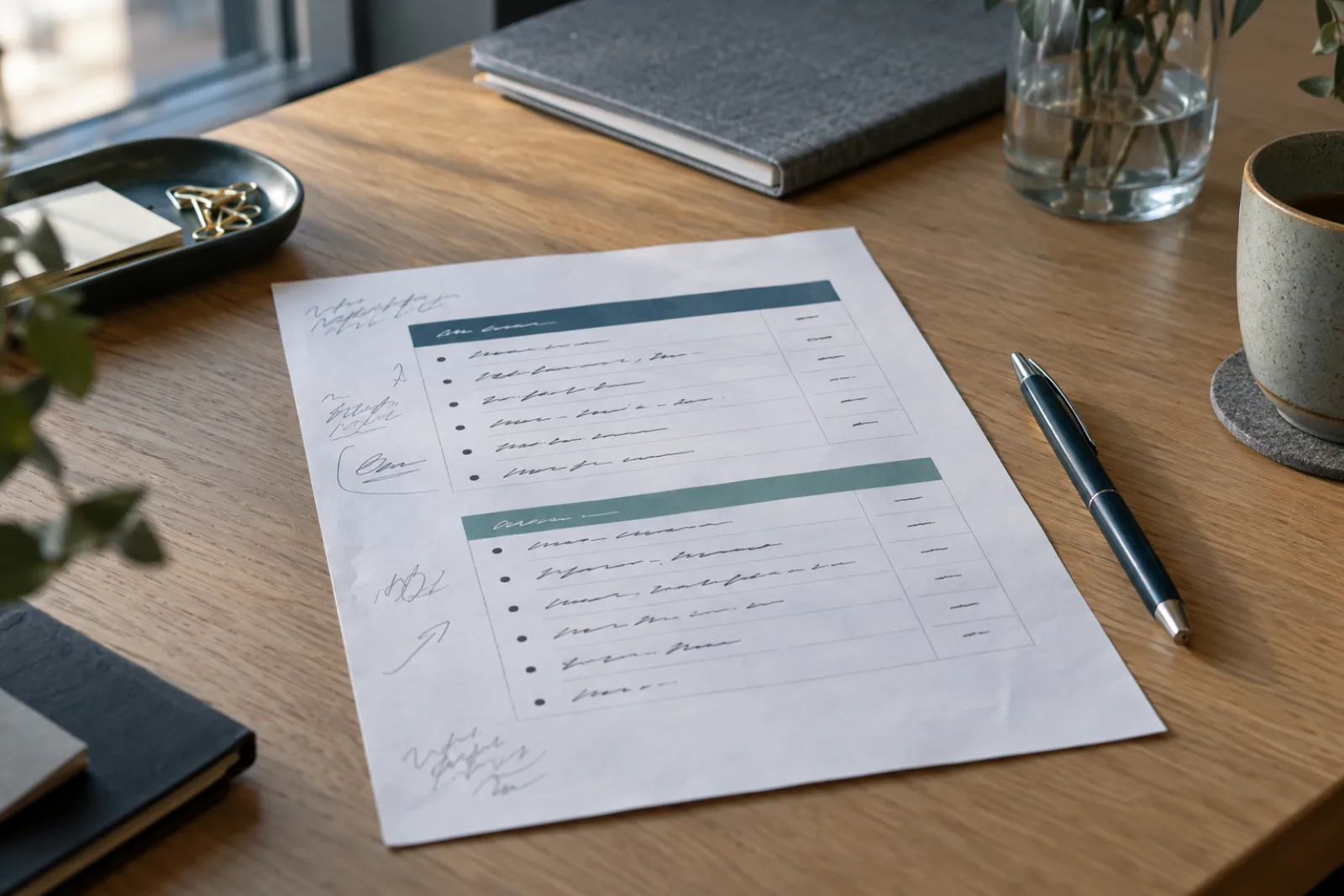
Every invitation should be preceded by one question, namely whether a topic really needs a meeting or whether a phone call and a short briefing would do. This is the most effective question of all, and it is almost never asked. Whoever asks it consistently cancels more meetings than any reduction initiative.
Five criteria that justify a meeting
Check a meeting against fixed criteria instead of gut feeling. First, a nameable goal. Second, a contribution from every invited person, who in turn takes something away themselves. Third, an outcome that justifies the time spent. Fourth, sufficient capacity, because the meeting creates work for the time afterward. And fifth, a clear classification as a status round or a working session, because the two run differently (blog.it-agile.de). If one criterion fails, the meeting is not yet lost. If two fail, it belongs under review. A missing meeting agenda is also a clear warning sign. Also set a review deadline for every recurring meeting, at the latest after a quarter. At that point, check whether the meeting is still needed and whether the attendees are still the right ones, because without a fixed checkpoint it keeps running until someone deletes it. The article on reducing unnecessary meetings shows how to turn this into a lasting routine.
When asynchronous is the better choice
According to a study by Loom, knowledge workers spend three hours and 43 minutes a day on communication, spread across emails, chats, video calls and phone calls (seibert.group). How much of that really needs everyone involved at the same minute? Status updates, sharing information and early idea collection often work better in writing, because everyone reads and answers at their own pace. What should stay synchronous are decisions with disagreement, resolving conflicts and anything that requires negotiation. The switch only works with solid documentation, though, because 56 percent of employees have to ask colleagues or schedule a meeting to get information they need (papershift.com). If the written basis is missing, the meeting comes back through the back door. Every meeting saved also saves more than its duration, because the re-immersion described above no longer applies. Once a meeting has passed the test, the attendee list decides the rest.
Who should attend, and who should not?
Under the Rule of 7, a group's decision-making capacity drops by ten percent with every additional member once it passes seven people, which is why groups of 17 or more rarely reach decisions at all (bain.com). The answer to the question, then, is as few as possible. 30 percent of respondents each name too many, or the wrong, attendees as a reason for inefficient meetings (datev-magazin.de). Plan the attendee list, then, just as carefully as the goal and the agenda. The Rule of 7 comes from management authors Marcia W. Blenko, Michael C. Mankins and Paul Rogers and describes not a law of nature but a rule of thumb from decision research. In practice, that means decision meetings should be capped at five to seven people. Whoever needs to inform more people should inform them in writing instead of inviting them. How many people sat in your last decision meeting, and how many of them actually spoke?
Roles, not an audience
Check every invitation by role, not by hierarchy. Who decides, who provides expert input, who facilitates, who documents? Everyone else receives the outcome. Large groups decide more slowly and often worse, because where many are listening, nobody takes responsibility for pushing back. The article on the biggest mistakes in meetings covers which mistakes in attendee selection happen most often. Once the group is set, what it decides has to hold up.
How do you record what was decided?
Almost half of all meetings do not get minutes at all. 51 percent record their outcomes, 49 percent do not, and on average 39.4 percent of the tasks decided never get implemented (buero-kaizen.de). Documentation, then, is not an administrative act but the point at which it is decided whether a meeting has any effect.
Decision, owner, deadline
Note three pieces of information for every outcome. What was decided, who implements it, and by when? If one of these is missing, it is not an outcome but a statement of intent. You cannot rely on attendees' memory here, because without follow-up, people forget an average of 70 percent of new information within 24 hours (openstax.org). Also record how the decision came about, meaning which options were on the table and which objections were raised. Can you still justify today why your team decided the way it did two quarters ago, and not otherwise? Complete minutes carry both, then, the action items for implementation at the top and the discussion record for research below. Together, this information forms the basis for effective meeting follow-up.
Who takes the minutes, and how
Settle who takes the minutes before the meeting, and do not hand the job to the person facilitating, because both tasks demand full attention. The guide on meeting minutes covers which type of minutes fits which occasion. For the "how," there are two methods to choose from, and they differ clearly in cost, outcome and confidentiality. Manual note-taking looks free, because no invoice arrives for it. In fact, it is the most expensive option, because it ties up working time twice, during the meeting and afterward while writing it up. At an average of 45.00 euros per hour worked (destatis.de), every half hour of follow-up work costs around 23 euros, not counting the time in the meeting itself. The cost grows with the number of meetings. Five meetings a week with minutes, each with half an hour of follow-up work, add up to around 4,800 euros over a working year, for a single person. On top of that, the outcome stays selective, because the minutes only contain what the note-taker considered important and could capture at the pace of the conversation. AI-powered recording flips this ratio and replaces a task that used to cost hours every week. Instead of a selection, a complete transcript is produced, on request with a screen recording, plus a draft summary and task list. Because everything is available verbatim, the meeting becomes searchable, so a decision from six months ago can be found through a search instead of a follow-up question, and some tools even let you ask questions about the meeting afterward. The difference between providers lies in where processing happens. In the cloud, every recording leaves the company; with locally operating tools like Jexity Meet, it stays on the machine by default, and for HR conversations and privileged matters, this is what the choice comes down to. Regardless of the method, one rule remains, because a draft does not replace sign-off on the content by the meeting leader. Once the minutes are sent out, though, the work is not yet done.
What happens after the meeting?
In most cases, the obvious thing follows, namely another meeting. Among German respondents, 71 percent of meetings end with scheduling a follow-up meeting (heise.de). That is rarely the desired outcome, and usually the result of missing ownership within the meeting itself.
The three pieces of information that carry a follow-up
In a reader survey by Büro-Kaizen, only 22 percent of respondents say tasks and responsibilities are always clearly resolved in their meetings (buero-kaizen.de). Reliable meeting follow-up, then, rests on the same three pieces of information as the minutes. Tools like Jexity Meet secure everything that emerged during the meeting in several formats in parallel for this purpose, namely audio recording, a verbatim transcript with speaker attribution, on request the screen recording, and a summary with a task list. Task, owner and deadline no longer have to be reconstructed after the fact. Send out the outcome the same day, and send it to the people you did not invite as well. This distribution point decides whether a small group can even function. The article on meeting follow-up shows how to turn outcomes into concrete actions and track them.
When a follow-up meeting is a symptom
A follow-up meeting is justified when information is missing that nobody in the room could provide. It is a symptom when the topic was unprepared, the person with decision authority was missing, or the goal was never put into a sentence. Keep a simple tally of reasons over four weeks. If the last three pile up, the problem is in the preparation, not the substance. Consistent meeting follow-up with documented tasks noticeably reduces the number of follow-up meetings. What works in one team, though, does not yet carry the whole organization.
How do you change the meeting culture in your company?
Four out of five managers run meetings without ever having learned how. Steven Rogelberg also estimates that about half the time spent organizing and holding meetings is unproductive, and that this creates around 65 billion euros a year in sunk wage costs in Germany (humanresourcesmanager.de). This is not an individual failing. Meeting management needs the same thing as any other operational task, then, namely ownership, training and metrics. Who in your organization has ever received guidance on meetings?
"Meeting management is an activity, not a position"
The sentence comes from organizational psychologist Prof. Dr. Nale Lehmann-Willenbrock. She sums up meeting management as covering everything that happens before, during and after the meeting, from planning the format, attendees, facilitation and agenda through to documentation and implementing the outcomes (topeins.dguv.de). The consequence is uncomfortable for org charts. Ownership cannot be pinned to a level in the hierarchy; it has to be carried by the team.
Starting in small steps
A company-wide policy usually fails because it is meant to apply equally everywhere. A format that works for a sales team becomes a chore in engineering. Instead of imposing a model on employees, those responsible should engage in dialogue and evaluate structures together (topeins.dguv.de). A meeting culture changes from the bottom up this way. In practice, that means one team tries out three rules, for example a mandatory agenda, a cap on attendees and a written outcome the same day. After four weeks, the team jointly evaluates what stuck, and only then does the next department follow. That is slower than an announcement from the top, but it holds, because the rules come from the team. The article on reducing unnecessary meetings, linked above, shows how such a change happens without losing information.
How you tell it is getting better
Perception alone is not a sufficient measure. Track three figures, then, each before the change and four weeks after, namely the share of meetings with a meeting agenda sent out in advance and a documented decision, the average number of attendees, and the amount of uninterrupted focus time. All three can be tracked in the calendar without extra software. Add a short piece of feedback right after the meeting that asks on a scale about clarity of purpose, attendee composition, preparation and goal orientation of the exchange (echonovum.com). Regularity matters more than length, because four questions after every meeting deliver more than a yearly survey with 40 items.
| Traits of good meetings | Share | Consequences of bad meetings | Share |
|---|---|---|---|
| Clear goals | 72% | Own work hindered | 44% |
| Clear agenda | 67% | Confusion in the workplace | 43% |
| Small group | 35% | Effects on customer relationships | 26% |
Two separate question batteries from the same survey, not on a shared scale. Source: Doodle: The State of Meetings (2019, 6,500 respondents).
Frequently asked questions
What makes a meeting effective?
A clearly formulated goal, an agenda with a time budget and the right number of attendees, the three most frequently named traits at 72, 67 and 35 percent (doodle.com). The test comes at the end. If the goal from the invitation can be judged as met or not met, the meeting was effective.
How long should a meeting last?
There is no sensible standard length, because the duration results from the sum of the time budgets on the meeting agenda, not from the calendar's default setting. A meeting guideline should explicitly counteract the one-hour habit (humanresourcesmanager.de). A meeting that needs 40 minutes should last 40 minutes.
How many attendees are optimal?
Five to seven for decisions, because decision-making capacity drops by ten percent with every additional member once a group passes seven people (bain.com). For pure information sharing, there is no upper limit, though a written update is usually the better choice there.
What belongs in a meeting agenda?
Four elements, namely a written goal, the topics, a time frame per item and a responsible person for each topic. Keep the topic list short and send the agenda at least 24 hours in advance along with the necessary materials, because missing lead time is the most common failure point.
How do you improve the meeting culture in a company?
With ownership, training and measurement instead of appeals, with meeting management treated as an activity that the whole team carries, not as a position (topeins.dguv.de). Start with one team, three rules and a measurement after four weeks.
Sources(20)
- cio.deCIO.de: 34 Stunden Langeweile in Meetings (2025, based on Atlassian data)
- buero-kaizen.deBüro-Kaizen: Besprechungsprotokoll, long-term study with AKAD University (since 2013, as of 2026)
- doodle.comDoodle: The State of Meetings (2019, 6,500 respondents)
- c-mw.netc-mw.net: Less Than Half of Meetings Properly Planned, Mentimeter Study (2019, 1,000 respondents)
- heise.deHeise: study, the most common outcome of meetings is more meetings (2024)
- bain.comBain & Company: Effective Decision Making and the Rule of 7 (2010, Blenko, Mankins, Rogers)
- blog.it-agile.deit-agile: Wenn Meetings den Kalender sprengen (2026)
- humanresourcesmanager.deHuman Resources Manager: Warum Meeting-Management in den HR-Fokus rücken sollte (2021, interview with Steven Rogelberg)
- topeins.dguv.deDGUV topeins: Wie Führungskräfte Meetings sinnvoll planen (2023, interview with Nale Lehmann-Willenbrock)
- business-wissen.deBusiness-Wissen: Meetings, tips for facilitating and leading a meeting
- seibert.groupSeibert Group: how asynchronous communication relieves teams and makes them more effective (2023, based on a Loom study)
- papershift.comPapershift: study, up to a quarter of working time in companies is spent searching for information (2025)
- controllerakademie.deController Akademie: good facilitation increases meeting efficiency (2019)
- datev-magazin.deDATEV Magazin: study, meetings are wasted time
- openstax.orgOpenStax: Psychology 2e, Problems with Memory (2020)
- ics.uci.eduGonzalez & Mark: No Task Left Behind? Examining the Nature of Fragmented Work (CHI 2005)
- research.vu.nlKauffeld & Lehmann-Willenbrock: Meetings Matter, Effects of Team Meeting Communication on Team and Organizational Success (2012)
- wz.deWZ: Wann Meetings die Arbeit bremsen (2026, interview with Eva Schulte-Austum)
- destatis.deDestatis: one hour of work cost an average of 45.00 euros in 2025 (2025)
- echonovum.comechonovum: 6 questions that lead to more efficient meetings
This article was created with AI assistance and editorially reviewed. Images are AI-generated.
Keep reading

Meeting Management: Rules and Methods for More Productive Meetings
Even well-prepared meetings often fail during execution. Studies show that more than half of meeting time passes unproductively. This article presents proven methods to help you get better results starting with your next meeting.
13 min read
Spotting Inefficient Meetings and Avoiding the Biggest Mistakes
Bad meetings are always the other person's fault, or so the thinking goes. It is the most common myth in meeting culture, and the data clearly disproves it. This article walks through the points where inefficient meetings take root, from the invitation to the minutes, and names the fix for each one.
16 min read
Meeting Follow-up: Turning Results Into Action
Every week, thousands of meetings end without clear ownership. The result is forgotten tasks, duplicated work, and follow-up meetings that repeat the same topic. This article shows the full path from a meeting outcome to a completed action.
12 min readTry it on your next meeting
Record or import one meeting and see the minutes it produces. No account and no credit card.