
How to Write Meeting Minutes: Structure, Tips, and Examples

On this page
- What are meeting minutes and why do you need them?
- Three functions of meeting minutes
- When are minutes legally required?
- What types of meeting minutes exist?
- Outcome minutes and decision minutes
- Progress minutes and verbatim minutes
- Brief minutes and retrospective minutes
- How are meeting minutes structured?
- Header
- Body
- Closing
- How do you write meeting minutes step by step?
- Before the meeting
- During the meeting
- After the meeting
- What do meeting minutes really cost?
- Cost example
- Hidden costs
- What methods exist for taking meeting minutes?
- Traditional methods
- Digital methods
- Why meeting minutes fail in everyday work
- Content mistakes
- Organizational mistakes
- What tools help with taking meeting minutes?
- Traditional tools
- AI-powered tools
- Frequently asked questions about meeting minutes
- Sources
Only 51% of all meetings end with meeting minutes. The remaining 49% end with good intentions but no written outcome. That is what a long-term study by Büro-Kaizen in collaboration with AKAD University (2026) found. The consequence is measurable. On average, 39% of tasks agreed on in meetings are never carried out, partly because the documentation is missing.
At the same time, German employees attend an average of 4.4 meetings per week. 2.9 of those are considered unnecessary (HR WORKS, 2025). Anyone who does not document meetings loses decisions and, along with them, the ability to prove which meetings were even necessary in the first place. But what should meeting minutes actually look like? This guide shows how to structure meeting minutes properly, which type of minutes fits which occasion, and how to create minutes with less effort that actually get read.
What are meeting minutes and why do you need them?
Meeting minutes are the written documentation of decisions, responsibilities, and open items from a meeting. According to the iBabs Global Meeting Survey (2024) with over 2,000 respondents, fewer than 50% believe that action items from meetings are adequately followed up on. Structured meeting minutes prevent this loss and make agreements binding. What separates useful minutes from ones that nobody reads? Three functions provide the answer.

Three functions of meeting minutes
Every set of meeting minutes serves three core purposes. The first is securing outcomes. What was decided? Without written documentation, memories blur faster than expected. According to the Flowtrace State of Meetings Report (2024), 52% of participants lose focus within the first 30 minutes. Whatever is not documented is lost after that.
The second function is accountability. Who does what by when? Only 22% of respondents to a Büro-Kaizen newsletter survey said that tasks and responsibilities in their meetings are always clearly defined (Büro-Kaizen). Good minutes close this gap by assigning each task to a specific person with a deadline.
The third function is traceability. Why was a decision made? This information becomes especially valuable when team members change or decisions are questioned months later.
When are minutes legally required?
In certain situations, meeting minutes are required by law. Works council meetings in Germany require a written record of every session under § 34 BetrVG (German Works Council Constitution Act). For a GmbH (limited liability company), a legal obligation for immediate written documentation exists only for single-shareholder companies under § 48 Abs. 3 GmbHG (German Limited Liability Companies Act). For multi-shareholder companies, GmbH law does not require minutes unless the articles of association or rules of procedure specify otherwise. The supervisory board of an AG (stock corporation) must record its meetings in writing under § 107 AktG (German Stock Corporation Act). Property owner meetings are likewise subject to mandatory documentation.
For project meetings, team dailies, and internal check-ins, there is no legal requirement. Nonetheless, documentation is strongly recommended, especially for HR conversations. Can you afford not to put agreements with employees in writing? Even without a legal requirement, you should write minutes here, because in a dispute they can serve as evidence.
What types of meeting minutes exist?
There are five common types of minutes. For most business meetings, outcome minutes are the most efficient choice. To keep decisions from getting lost, you need the right format.
Outcome minutes and decision minutes
Outcome minutes and decision minutes are closely related and often treated as interchangeable in practice. Both document the result of a meeting, not the course of the discussion. The difference lies in scope. Decision minutes record only the formal voting results, while outcome minutes also summarize the key discussion points and action items. For project meetings and team check-ins, outcome minutes are the best choice because they require the least effort and offer the highest relevance for follow-up. When are pure decision minutes worthwhile? Primarily in formal bodies such as boards of directors or supervisory boards, where only the vote outcome matters.
Progress minutes and verbatim minutes
Progress minutes reproduce the course of conversation in chronological order, with individual contributions rendered in indirect speech. They document who raised which argument and make the decision-making path traceable. The effort is significantly higher than for outcome minutes, both during the meeting and in the write-up. This format suits negotiations, mediation sessions, and meetings where the line of reasoning must be documented.
Verbatim minutes go one step further. They record contributions word for word, sentence by sentence. This is the most labor-intensive type of minutes and is primarily used in court proceedings, parliamentary sessions, and notarial certifications. Does your team really need this level of detail, or would outcome minutes suffice?
Brief minutes and retrospective minutes
Brief minutes capture only the most important points on half a page and are suitable for short stand-ups or status updates. Retrospective minutes are written after the fact from memory when real-time note-taking was not possible. This is the most error-prone format, but still better than no minutes at all.
| Type of minutes | Level of detail | Effort | Typical use case |
|---|---|---|---|
| Outcome and decision minutes | Decisions and action items, outcome minutes also add the key points | Low | Project meetings, team check-ins, formal bodies |
| Progress minutes | Course of discussion with contributions in indirect speech | Significantly higher | Negotiations, mediation sessions |
| Verbatim minutes | Every contribution word for word | Highest | Court proceedings, parliamentary sessions, notarial certifications |
| Brief minutes | Most important points on half a page | Low | Stand-ups, status updates |
| Retrospective minutes | Written afterwards from memory, error-prone | Write-up only | When real-time note-taking was not possible |
A detailed comparison of all types of minutes with a decision guide is available in the article Types of minutes compared.
How are meeting minutes structured?
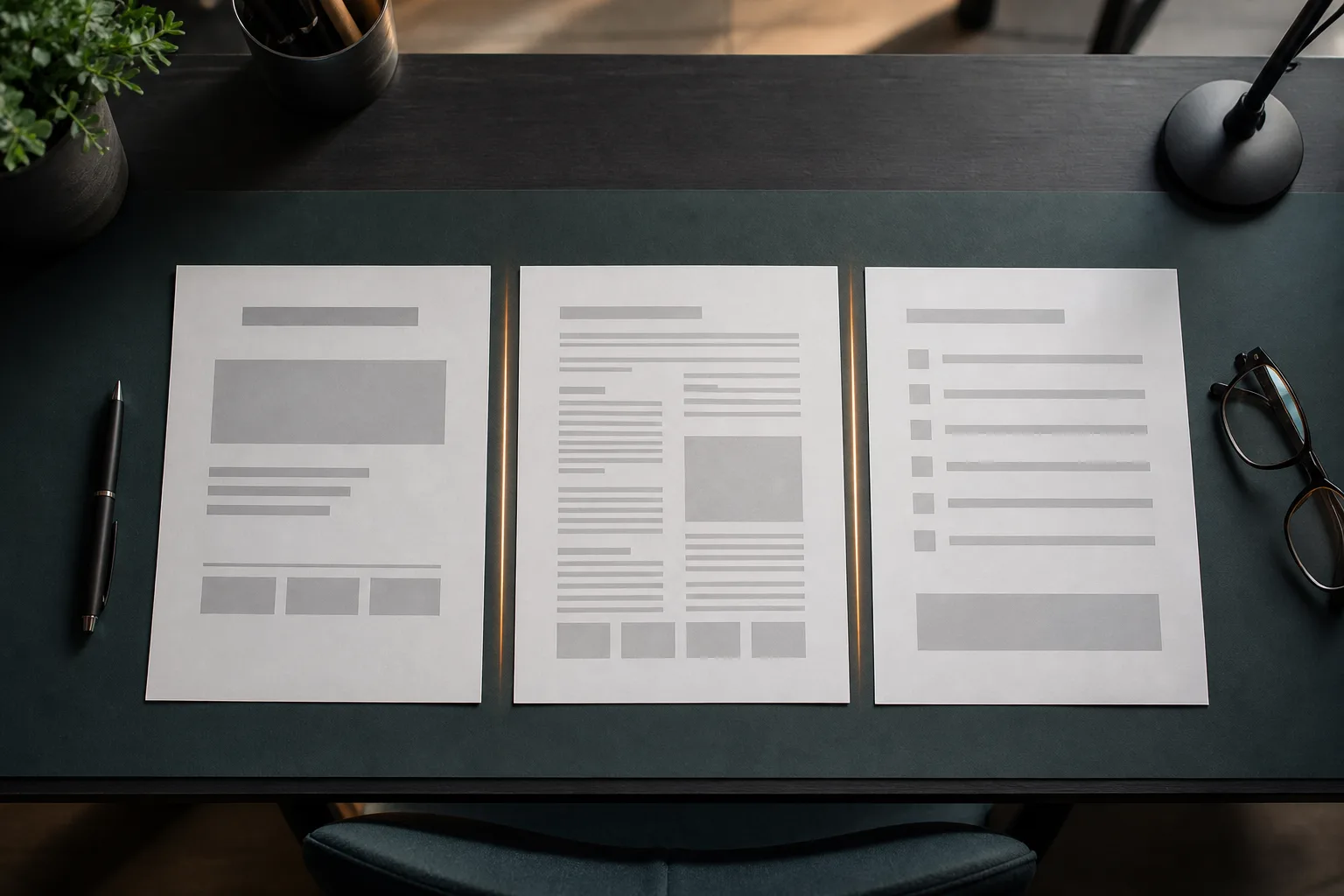
Every set of meeting minutes consists of three parts. Header, body, and closing. This basic structure applies regardless of the type of minutes and provides the framework that the minute taker follows. Why do many minutes fail despite good intentions? Often, a clear meeting minutes template that defines the structure is missing.
Header
The header contains all the organizational details about the meeting. These include the date and time, the location or video conference link, the names of all participants (present and absent with apologies), the name of the minute taker and the meeting chair, and the topic or title of the meeting. These details may seem like formalities, but they are critical for later attribution and legal admissibility. A good meeting minutes template already has these fields pre-filled, so nothing gets forgotten. Who participated in the decision? Without the header, this question cannot be answered months later.
Body
The body follows the agenda and documents each agenda item individually. In outcome minutes, each item includes the decision, the responsible person, and the deadline. In progress minutes, individual contributions in indirect speech are added.
A common mistake is writing down discussions instead of documenting outcomes. Meeting minutes should record what was decided, not who said what. The exception is progress minutes, where the flow of discussion is intentionally part of the documentation.
Closing
The closing brings together everything that needs to happen after the meeting. This includes the task assignments with specific responsibilities and deadlines, a summary of all open items, and the date and topic of the next meeting. For formal minutes, the signatures of the minute taker and the meeting chair are added.
A correction window should also be noted here. A period of three to five business days has proven effective so that participants can report errors or additions. Whoever writes the closing carefully saves follow-up questions and ensures that everyone knows what to do next.
How do you write meeting minutes step by step?
The most efficient method for writing minutes follows a clear sequence. Prepare, take notes, finalize, send. According to meetergo (2026), the post-meeting wrap-up alone takes 15 to 30 minutes per hour of meeting time. With good preparation, this effort can be reduced significantly. How do you prevent the wrap-up from taking longer than the meeting itself?
Before the meeting
Prepare a meeting minutes template with the header and agenda already filled in. Also clarify who will take the minutes. This decision should not be made during the meeting. When the minute taker is assigned beforehand, they can prepare for the task and pre-fill the template with the known agenda items. Ten minutes of preparation easily save twice that time in the wrap-up.
During the meeting
For outcome minutes, the rule of thumb is to write in bullet points, not full sentences. Focus on decisions, action items, and deadlines. For progress or verbatim minutes, the approach is different. Here you need to capture contributions as completely as possible, word for word in the case of verbatim minutes. That requires considerably more concentration and leaves little room for participating in the discussion yourself.
Regardless of the type of minutes, it helps to briefly summarize what was decided after each agenda item and ask the group to confirm. If a statement is unclear, ask immediately. It is better to pause briefly than to guess later.
After the meeting
Finalize the meeting minutes within 24 hours. The longer the delay, the more details are lost. According to a survey by Wundamail (2024), 30% of employees fail to complete meeting tasks simply because they no longer remember them. Send the finished minutes to all participants and set a correction window of three to five business days. If you have to create minutes regularly, it is best to establish a fixed routine from note-taking to sending.
Also consider the hidden time drain after the meeting. After every interruption, knowledge workers need an average of 23 minutes to fully refocus on their original task (Gloria Mark, UC Irvine, 2020). Quick finalization of the minutes minimizes this context switch.
The complete workflow from preparation to follow-up is described in detail in the article Creating minutes.
What do meeting minutes really cost?
A single set of meeting minutes costs companies up to 68 euros in labor time. Projected over a year, these costs easily reach five figures. Poorly organized meetings cause an estimated 64 billion euros in losses per year across Germany (Doodle, 2023). Anyone who never calculates the cost of their own minute-taking process significantly underestimates the actual effort involved.
Cost example
According to meetergo (2026), post-meeting wrap-up takes 15 to 30 minutes per hour of meeting time. At an average gross hourly rate of 45 euros (Destatis, 2025), that amounts to at least 11 to 23 euros per set of minutes for the wrap-up alone. The minute taker is also occupied during the one-hour meeting itself and unavailable for other tasks. Adding that hour at 45 euros brings the true cost to 56 to 68 euros per set of minutes. Creating minutes by hand therefore costs considerably more than the pure writing time suggests.
German employees have an average of 4.4 meetings per week (HR WORKS, 2025). The weekly costs add up to over 100 euros per minute taker. Projected over a year, that is more than 5,000 euros, and that is for just one person on the team.
Hidden costs
Beyond the direct time investment, there are costs that never show up in any calculation. Every interruption caused by finalizing minutes costs an average of 23 minutes of recovery time before the original task can be resumed (Gloria Mark, UC Irvine, 2020). On top of that come follow-up questions about unclear wording and flawed decisions that trace back to incomplete minutes.
What happens when nothing is documented at all? Discussions repeat in the next meeting. Decisions are forgotten. Responsibilities remain unresolved. And new team members have no access to past decisions. How much effort does this cost your team?
The full cost breakdown with examples for different team sizes is available in the article Meeting minutes costs.
What methods exist for taking meeting minutes?
From handwritten notes to automatic transcription, there are five methods that differ significantly in effort, accuracy, and data privacy. According to a study by HR WORKS (2025), 68% of German employees rate their meeting time as ineffective. The right method can reduce that share. But do you really still need to take notes by hand?
Traditional methods
Three traditional approaches dominate in practice. Handwritten note-taking with pen and paper is the oldest form. It requires no technology, works anywhere, and forces you to filter and summarize information immediately. The downsides, however, are significant. Whoever writes hears less effectively and misses contributions. The results are often incomplete, hard to read, and impossible to search. Laptop note-taking in a word processor is faster, easier to format, and immediately digital. It does carry the risk of transcribing verbatim instead of summarizing, and open tabs and notifications are a constant distraction. The keyword method relies on brief notes during the meeting and detailed write-up afterward. It produces structured results but requires disciplined follow-through within a few hours.
All three methods share a fundamental problem. Anyone who writes minutes by hand must simultaneously listen, think, and document. That costs an additional 15 to 30 minutes of wrap-up per hour of meeting time (meetergo, 2026) and ties up one person entirely who cannot contribute to the discussion during that time.
Digital methods
Two more modern approaches solve this fundamental problem. Audio recording with manual write-up captures the entire conversation and allows the minute taker to focus fully on the discussion. The recording serves as a safety net when bullet points are unclear. The downside is the time-consuming post-processing, as the entire recording must be listened to again.
Automatic transcription with AI summarization takes it a step further and offers the highest degree of automation. The meeting is transcribed in real time, speaker recognition assigns statements to the right people, and an AI-powered summary extracts decisions and action items automatically. The minute taker can concentrate entirely on the conversation. Modern solutions work across platforms and are compatible with any conferencing software, phone calls, and even in-person meetings. For German companies, data privacy is a central concern. Cloud-based solutions transmit audio data to external servers, which can be problematic for confidential meetings. Local solutions like Jexity Meet process the data on your own machine by default and also work offline once the models are downloaded. By default, no audio data leaves the company in the process.
Which method suits your team depends on meeting frequency, budget, and data privacy requirements.
A detailed comparison of all five methods with costs and practical examples is available in the article AI meeting minutes or manual notes? Methods compared.
Why meeting minutes fail in everyday work
The most common mistake in writing meeting minutes is not too little detail, but too much. That 39% of agreed tasks are never carried out rarely comes down to missing minutes alone, but rather to recurring mistakes in how the minutes are taken.
Content mistakes
Three content mistakes repeat in almost every team. Missing responsibilities and deadlines make decisions non-binding. When it is not clear who acts by when, usually nothing happens. Interpretation instead of documentation distorts the outcomes, especially on controversial topics. And missing decisions, where only the discussion is documented, leave out the most important part. Have you ever read minutes that recorded what was discussed but not what was decided?
Organizational mistakes
Four organizational mistakes compound the problem. Minutes sent out too late lose their binding force because participants' memories have already faded. Without a consistent meeting minutes template, the minute taker has to start from scratch at every meeting, increasing the effort unnecessarily. Unclear minute-taking assignments mean nobody feels responsible and the minutes never get written at all. And a missing feedback process means errors in the minutes go uncorrected.
According to Zoom (2025), 54% of employees want meeting summaries with action items. Only 39% actually receive them. Why is that? The gap does not stem from a lack of willingness, but from these organizational shortcomings.
All eight mistakes with concrete solutions are described in the article The most common mistakes in meeting minutes.
What tools help with taking meeting minutes?
From a simple Word document to AI-powered transcription, there are tools for every budget and every requirement. But even the best tool is of little use when the process is broken. According to Flowtrace (2025), only 37% of all meetings use an agenda. Technology alone does not solve this problem, it takes the combination of clear structure and the right tool. Does your team need a specialized tool, or is a good template enough?
Traditional tools
Microsoft Word, Google Docs, Notion, and OneNote are the most widely used options. Most teams already have at least one of these tools in use. The advantages are obvious, namely quick setup, no additional costs, and a minimal learning curve. The disadvantages, however, become significant with regular use. Manual minute taking ties up one person entirely, which limits their active participation in the meeting. The labor cost per set of minutes is high because note-taking, wrap-up, and formatting all take time. And the neutrality of the documentation is compromised because subjective perception and omissions are inevitable.
AI-powered tools
AI tools automate the most time-consuming steps of minute taking. Meeting transcription converts speech to text. Automatic summarization extracts decisions and action items. Speaker recognition assigns statements to the right people. For confidential meetings, what matters most is where the data is processed. Local solutions like Jexity Meet process it on your own machine by default. Is it worth adopting AI-powered minute taking for your team? If you have to create minutes regularly, from just a few meetings per week onward you save working time that is worth more than an AI solution costs.
Frequently asked questions about meeting minutes
Who should write the minutes during a meeting?
Ideally, someone who is not actively participating in the discussion. In small teams, the role rotates. The minute taker should be assigned before the meeting, not decided on the spot. Whoever is to write the minutes needs access to the agenda and the template in advance. According to a Büro-Kaizen newsletter survey, only 22% of respondents say that tasks in their meetings are always clearly defined.
How long should meeting minutes be?
As short as possible, as long as necessary. Outcome minutes for a one-hour meeting fit on a single page with 300 to 500 words. Progress minutes may run two to three pages. The decisive question is not length but whether all decisions, responsibilities, and deadlines are documented.
When should the minutes be sent out?
Within 24 hours, at the latest by the next business day. The longer the delay, the more details are lost. According to a survey by Wundamail (2024), 30% of employees fail to complete meeting tasks because they no longer remember the agreements.
Are meeting minutes legally binding?
Meeting minutes are not automatically legally binding, but they can serve as evidence. Legal documentation requirements exist for works council meetings (§ 34 BetrVG, German Works Council Constitution Act), single-shareholder GmbH companies (§ 48 Abs. 3 GmbHG, German Limited Liability Companies Act), supervisory board meetings (§ 107 AktG, German Stock Corporation Act), and property owner meetings. For multi-shareholder GmbH companies, there is no legal requirement unless the articles of association specify otherwise. In all other cases, minutes have no automatic legal force but strengthen your position in a dispute.
What is the difference between outcome minutes and progress minutes?
Outcome minutes record only decisions and action items. They are short and focused on action items. Progress minutes document the flow of discussion chronologically with contributions rendered in indirect speech. For most business meetings, outcome minutes are sufficient. More on this in the article Types of minutes compared.
Sources(14)
- buero-kaizen.deBüro-Kaizen/AKAD: Meeting minutes (2026)
- ibabs.comiBabs: Global Meeting Survey (2024)
- flowtrace.coFlowtrace: 50 Meeting Statistics (2025)
- flowtrace.coFlowtrace: State of Meetings Report (2024)
- digitaleneuordnung.deDoodle: Meeting statistics, via Digitale Neuordnung (2023)
- computerwoche.deHR WORKS: Meeting overload study, via Computerwoche (2025)
- news.uci.eduGloria Mark, UC Irvine: Asynchronous communications can help reclaim lost time (2020)
- meetergo.commeetergo: Meeting minutes (2026)
- zoom.comZoom: Meeting Statistics (2025)
- notta.aiWundamail: Meeting tasks, via Notta Meeting Statistics (2024)
- gesetze-im-internet.deGesetze im Internet: § 34 BetrVG, written record (German Works Council Constitution Act)
- gesetze-im-internet.deGesetze im Internet: § 48 GmbHG, shareholder meeting (German Limited Liability Companies Act)
- destatis.deDestatis: Labor costs (2025)
- gesetze-im-internet.deGesetze im Internet: § 107 AktG, internal rules of the supervisory board (German Stock Corporation Act)
This article was created with AI assistance and editorially reviewed. Images are AI-generated.
Keep reading

Creating Meeting Minutes: From Meeting to Finished Document
Meetings end, tasks fall through the cracks. The reason is almost always missing or incomplete minutes. This guide walks through the complete process, from preparation and note-taking to follow-up, so decisions actually turn into results.
16 min read
Meeting Management: Rules and Methods for More Productive Meetings
Even well-prepared meetings often fail during execution. Studies show that more than half of meeting time passes unproductively. This article presents proven methods to help you get better results starting with your next meeting.
13 min read
The Most Common Mistakes in Meeting Minutes
Meeting minutes can create clarity or cause confusion. This article covers the eight most common minute-taking mistakes and delivers concrete solutions so your meeting minutes actually deliver value.
13 min readTry it on your next meeting
Record or import one meeting and see the minutes it produces. No account and no credit card.