
Types of Meeting Minutes Compared: Which Fits Your Meeting?
On this page
- What are the types of meeting minutes, and why does the choice matter?
- What matters when choosing
- What happens if you choose the wrong format?
- What types of meeting minutes are there?
- Resolution minutes and action minutes
- Discussion minutes
- Brief minutes
- Minutes from memory and verbatim minutes
- When is which type of minutes the right choice?
- Why a recording is always the best foundation
- When are meeting minutes legally required?
- Statutory documentation requirements
- Voluntary, but recommended
- How do meeting minutes turn into results?
- Track to-dos and responsibilities consistently
- Look things up anytime and retrieve the context
- Why recording with transcription is the most efficient method
- The gap between expectations and reality
- Time savings and task follow-through
- What AI-powered minute-taking can do today
- Avoiding typical mistakes
- Frequently asked questions about types of meeting minutes
- Sources
72% of all meetings are considered ineffective. That is the finding of an Atlassian study of 5,000 knowledge workers across four continents (2024). The right type of meeting minutes cannot solve this problem on its own, but it determines whether the outcomes are at least captured.
This article covers all five common types of meeting minutes and explains the differences. Above all, it shows why a complete recording with automatic transcription is the best foundation for any kind of minutes, whether brief minutes, action minutes, or discussion minutes.
What are the types of meeting minutes, and why does the choice matter?
Types of meeting minutes differ along three dimensions, namely what gets documented, in how much detail, and how binding the result is. The wrong choice either wastes time unnecessarily or puts decisions at risk. According to the iBabs Global Meeting Survey (2024, n=2,000+), fewer than half of all respondents feel that the action points from meetings are adequately followed up. According to a Reclaim.ai survey (2024), meetings cost companies an average of 29,129 dollars per employee per year. With sums like these, the choice of minutes format decides whether the time invested turns into usable results.
What matters when choosing
The differences come down to three questions.
- Content: Are only outcomes recorded, or the course of the discussion as well?
- Level of detail: Are bullet points enough, or are full sentences needed?
- Bindingness: Do the minutes serve as an internal memory aid or as a legally relevant document?
What happens if you choose the wrong format?
Minutes that are too detailed mean nobody reads them. Minutes that are too sparse mean decisions cannot be traced. According to the Asana State of Work Innovation Report (2024), 28% of all meetings cause a so-called "meeting hangover", where employees need extra time afterwards to regroup and brief colleagues. The follow-up work should reduce this effect, not amplify it.
What types of meeting minutes are there?
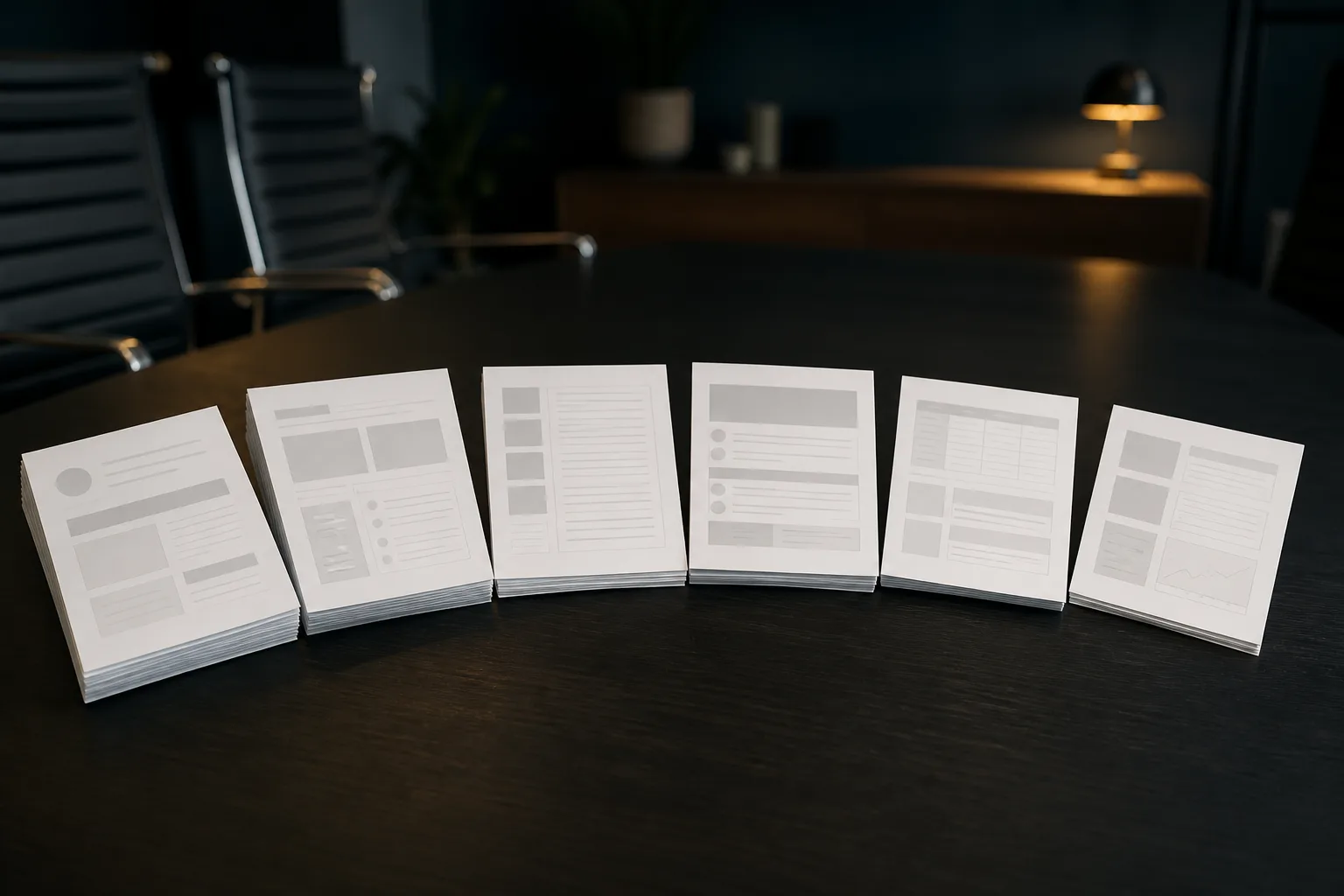
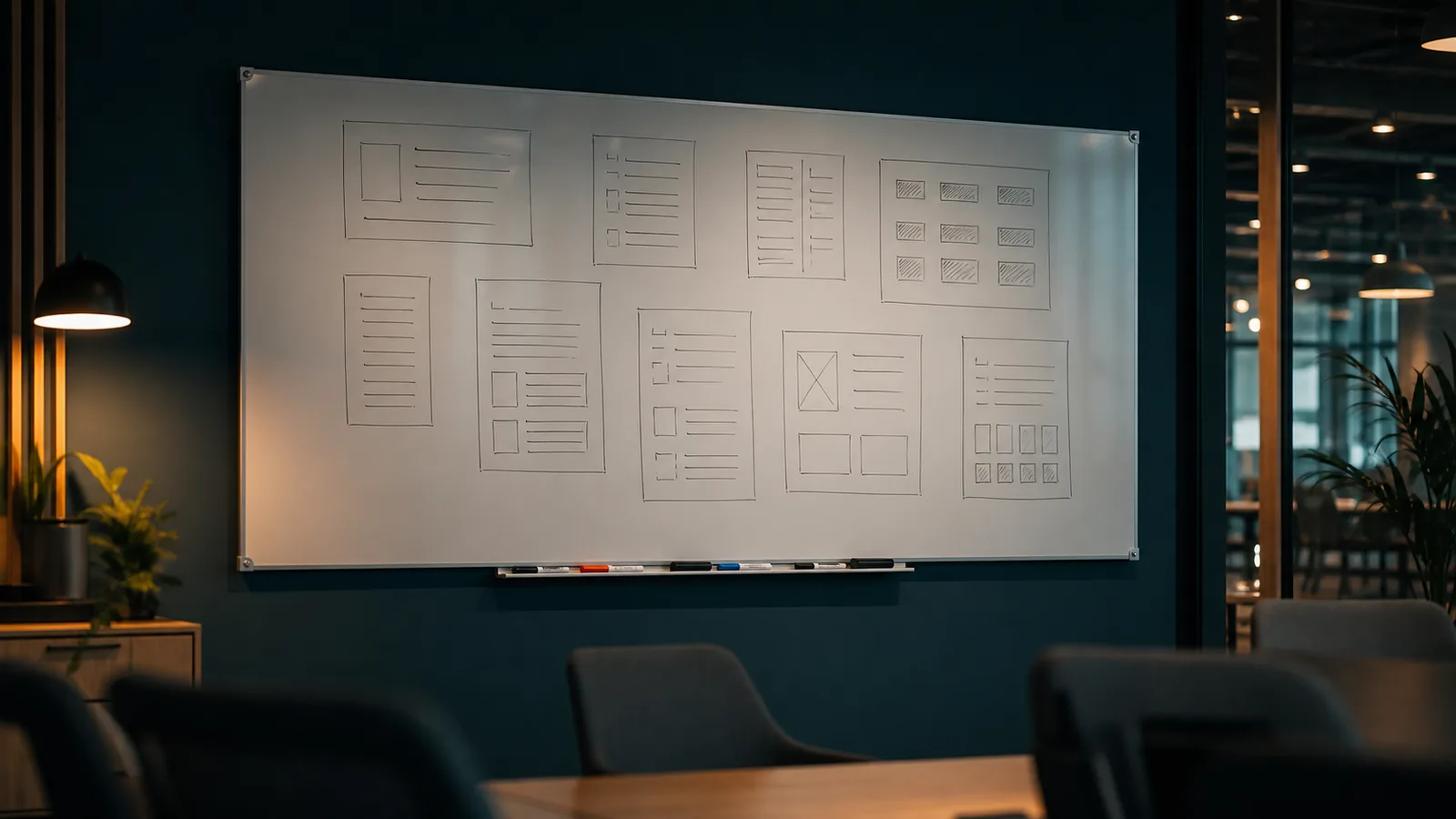
There are five common types of meeting minutes. For operational business meetings in small and mid-sized companies, action minutes and brief minutes are the most frequent formats. The other three serve specific purposes you should know about.
Resolution minutes and action minutes
Resolution minutes and action minutes document decisions, responsibilities, and deadlines. The path of the discussion is not recorded, which makes this the most efficient format for project, team, and client meetings. The difference between the two variants is small. Resolution minutes record only the formal voting results, while action minutes also summarize the most important points of substance and the tasks. The follow-up work takes only 10 to 15 minutes.
Discussion minutes
Discussion minutes reproduce the course of the discussion chronologically and record who contributed which arguments. The advantage is that decisions remain traceable even months later. Anyone who wants to look up why a particular direction was chosen finds the arguments in the minutes. A good discussion minutes template contains a header, a timestamp per contribution, and a field for open items. The downside is 30 to 60 minutes of follow-up work per meeting.
Brief minutes
Brief minutes are the most condensed format. One sentence on the outcome per agenda item, half a page at most for the entire meeting. Follow-up work takes less than five minutes. Quick to create, quick to read, and ideal for teams that align regularly. Dailies, weeklies, and recurring syncs benefit most from this format.
Minutes from memory and verbatim minutes
Minutes from memory are a personal, informal memory aid with no fixed form. And verbatim minutes reproduce every statement word for word, as known from parliamentary debates. In everyday business, they practically never occur.
| Type of minutes | Level of detail | Follow-up time | Legal obligation | Typical use |
|---|---|---|---|---|
| Action minutes | Decisions, key points, tasks, deadlines | 10 to 15 min | No | Project, team, and client meetings |
| Resolution minutes | Formal resolutions and voting results | 10 to 15 min | Works council (§ 34 BetrVG), supervisory board of a German AG (§ 107 AktG), single-member GmbH (§ 48 Abs. 3 GmbHG) | Shareholder meetings, supervisory board meetings |
| Discussion minutes | Chronological course of discussion | 30 to 60 min | No | Negotiations, complex decisions |
| Brief minutes | One sentence per agenda item | under 5 min | No | Dailies, weeklies, recurring syncs |
| Minutes from memory | Personal notes, no set form | varies | No | Personal notes after a conversation |
| Verbatim minutes | Every statement word for word | very high | Where required | Parliamentary debates |
When is which type of minutes the right choice?
The right type of minutes depends on the purpose of the meeting. For most operational meetings in everyday work, action minutes that record decisions and tasks are enough. Short, recurring check-ins can be covered with brief minutes in a few bullet points. As soon as the path of the discussion needs to stay traceable, for example in negotiations or complex decisions, discussion minutes are the right fit. In formal bodies such as shareholder meetings or supervisory board meetings, resolution minutes are used. Anyone taking minutes in a board meeting should also record resolutions and voting results in full, because liability questions can depend on them. And anyone who only wants to jot down the key points for themselves after a conversation reaches for minutes from memory.
In practice, you can define the type of minutes once for recurring meetings and then stick with it. If you regularly need discussion minutes, use a standardized discussion minutes template to reduce the time involved. Most teams get by with action minutes as the standard format and only switch to the more detailed form when a decision needs particularly thorough documentation.
Why a recording is always the best foundation
Regardless of the format you choose, it pays to record the conversation in full and have it transcribed automatically. From a complete audio or video recording with a transcript, you can derive any type of minutes, whether brief minutes, action minutes, or discussion minutes.
The decisive advantage is that manual note-taking always loses information. According to the Microsoft Work Trend Index 2025, employees are interrupted on average every two minutes by a meeting, an email, or a chat message. Anyone expected to listen, contribute, and take notes at the same time cannot do any of these tasks well. A recording frees all participants from this double duty.
If you capture the conversation, and optionally the video, you always have the complete foundation. Decisions, responsibilities, and open items can be cleanly extracted afterwards. And if a decision is questioned weeks later, the context is available at any time.
When are meeting minutes legally required?
In certain constellations, minutes are required by law, for example the written record of a works council meeting or the minutes of a supervisory board meeting of a German stock corporation. For everyday team meetings there is no obligation, but a strong recommendation.
Statutory documentation requirements
German law explicitly mandates minutes in several cases. For works council meetings, §34 BetrVG requires a written record of every session that must contain at least the wording of the resolutions and the voting majority.
For supervisory board meetings of a German stock corporation, §107 AktG makes a written record mandatory. For management board meetings, by contrast, the German Stock Corporation Act does not require minutes. Many rules of procedure still make minutes of board meetings mandatory, because in a dispute, board members have to prove that they acted with due care (§93 AktG).
For the shareholder meeting of a German GmbH, the situation is more nuanced. A statutory obligation to prepare a written record without delay exists only for the single-member GmbH under §48 Abs. 3 GmbHG. For a company with several shareholders, GmbH law does not require minutes, unless the shareholders have agreed on such an obligation in the articles of association or rules of procedure.
Owners' meetings under the German Condominium Act (WEG) require minutes: under §24 Abs. 6 WEG, a record of the resolutions passed must be made without undue delay and signed by the chair, one unit owner and, if there is an advisory board, its chair. The statute sets no deadline in weeks for this. For registered associations, §58 Nr. 4 BGB says the articles of association should set out how resolutions of the general meeting are recorded.
Voluntary, but recommended
There is no legal obligation to take minutes of HR conversations. From an employment law perspective, however, minutes of an employee meeting are strongly recommended, especially for written warnings, target agreements, or conflict conversations. Client appointments and project meetings also benefit from minutes.
According to a study by the London School of Economics (2024) with 3,400 respondents, more than a third of all business meetings are unproductive. For the US, the study puts the annual damage at 259 billion dollars. Minutes alone do not solve this problem, but without documentation there is no basis for follow-up at all.
How do meeting minutes turn into results?
Minutes only fulfill their purpose once they lead to concrete actions, whether team minutes or the minutes of a board meeting. What matters is less the type of minutes than consistent follow-up.
Track to-dos and responsibilities consistently
Every meeting should end with a clear list of who does what by when. These three elements are the core of any useful minutes. Without them, the document remains a summary without effect.
Many employees leave meetings without knowing who owns the next steps. This can be avoided if tasks are assigned and tracked right after the meeting. Automatically generated minutes with extracted action items make this step easier because nothing has to be compiled manually.
A fixed routine has proven effective, in which the tasks are assigned, deadlines confirmed, and the minutes sent to everyone involved within 24 hours after the meeting. Sticking to this rhythm prevents decisions from being forgotten.
Look things up anytime and retrieve the context
Decisions are often questioned weeks or months later. Who agreed? What were the arguments? What was the condition? Action minutes answer these questions partially, but only a recording provides the full context.
If the entire conversation is available as audio or video with a transcript, everyone involved can listen back or read up on what was discussed at any time. New team members work their way into past decisions on their own, without having to ask colleagues every time. And if there is any ambiguity about the exact wording of a decision, the transcript provides the answer.
Especially in teams with high turnover or many parallel projects, this capability becomes a decisive advantage. Instead of storing knowledge in the heads of individuals, it becomes accessible to everyone in a searchable recording. Tools like Jexity Meet offer a chat function that lets you ask the transcript targeted questions.

→ AI meeting minutes or manual notes? Methods compared
Why recording with transcription is the most efficient method
Manual note-taking fails at a fundamental problem. Whoever takes notes cannot listen and contribute at the same time. According to the Microsoft Work Trend Index 2025, employees are interrupted on average every two minutes. Under these conditions, complete manual note-taking is practically impossible.
The gap between expectations and reality
According to Zoom (2025), 54% of employees want meeting summaries with action items, but only 39% actually receive them. This 15-percentage-point gap shows that manual minute-taking systematically fails to deliver what teams need.
A complete recording with automatic transcription closes this gap. Decisions, responsibilities, and deadlines can be extracted from the transcript without anyone having to take notes during the meeting. All participants can focus fully on the conversation.
Time savings and task follow-through
According to a survey by the vendor Otter.ai (2024), 62% of professionals save more than four hours per week with AI-powered transcription. Manual follow-up work disappears or shrinks to a quick review of the automatically generated minutes.
The market for AI-powered meeting assistants is growing accordingly. According to market.us (2025), the global market volume is set to rise from 2.68 billion dollars (2024) to an expected 24.6 billion dollars by 2034. Companies are increasingly investing in automated minute-taking because manual note-taking no longer scales as meeting frequency rises.
The biggest advantage is that you do not have to commit to a type of minutes in advance. From a complete recording, you can derive the right format at any time, whether brief minutes, action minutes, or discussion minutes.
What AI-powered minute-taking can do today
Modern transcription tools now offer more than just a written version of what was said. Depending on the vendor, the following features are standard.
- To-dos, summaries, and decisions are extracted automatically from the conversation, with no manual rework
- Local processing without cloud upload, so sensitive conversation content never leaves your own machine
- Ask questions about the transcript, such as "What was said about the budget?" or "What objections were raised?"
- Shared screen content such as presentations or spreadsheets flows automatically into the summary
- Multilingual meetings are transcribed across languages and can be output in a single language
Solutions like Jexity Meet combine these features locally on your own machine by default, without sending audio data to external servers.
Avoiding typical mistakes
Most mistakes in meeting minutes come down to three causes, namely no documentation, sending too late, and missing task assignment. Recording meetings as a rule and having them transcribed automatically removes the most common source of errors at the root. The right type of minutes then ensures that the results reach the team in the right format.
Frequently asked questions about types of meeting minutes
What is the difference between action minutes and discussion minutes?
Action minutes record only decisions, responsibilities, and deadlines. Discussion minutes additionally document the chronological course of the discussion. If you record and transcribe the meeting, you can derive both variants from the transcript without having to commit in advance.
Are brief minutes sufficient for official meetings?
For internal team meetings, dailies, and recurring syncs, brief minutes are ideal. For works council meetings they are not sufficient, because §34 BetrVG requires a written record with resolutions and voting majorities, and neither are they for resolutions of a single-member GmbH (§48 Abs. 3 GmbHG). In practice, the same applies to shareholder meetings with several shareholders and to the minutes of a board meeting, even without a statutory requirement. When in doubt, use action minutes instead.
Who decides which type of minutes is used?
Usually the person who calls the meeting, or the meeting chair. For legally mandated minutes, the law dictates the format. For all other meetings, it is best to define the type of minutes together with the agenda before the meeting.
Can different types of minutes be combined?
Yes, and that is exactly the advantage of a complete recording. If the entire meeting is available as a transcript, you can create action minutes for the team, discussion minutes for the records, and brief minutes for the leadership team, all from the same source.
Which type of minutes is suitable for HR conversations?
For HR conversations, action minutes work best. Minutes of an employee meeting record agreements, goals, and deadlines without documenting the emotional course of the conversation. For written warnings or conflict conversations, discussion minutes can make sense to secure the course of the conversation from an employment law perspective. Both sides should countersign the minutes.
Sources(13)
- atlassian.comAtlassian: Workplace Woes, Meetings (2024, study, 5,000 respondents)
- ibabs.comiBabs: Global Meeting Survey (2024, n=2,000+)
- asana.comAsana: State of Work Innovation Report (2024, industry study)
- blogs.microsoft.comMicrosoft: Work Trend Index 2025 (global study + M365 telemetry)
- zoom.comZoom: Meeting Statistics (2025, workplace survey)
- otter.aiOtter.ai: Productivity Survey (2024, survey, 600+ respondents)
- lse.ac.ukLondon School of Economics: More than a third of business meetings are unproductive (2024, study, 3,400 respondents)
- gesetze-im-internet.de§48 GmbHG: shareholder meetings (statute text)
- gesetze-im-internet.de§34 BetrVG: written record of works council meetings (statute text)
- gesetze-im-internet.de§107 AktG: internal organization of the supervisory board (statute text)
- gesetze-im-internet.de§93 AktG: duty of care and liability of management board members (statute text)
- reclaim.aiReclaim.ai: Smart Meetings Report (2024)
- market.usmarket.us: AI-Powered Meeting Assistants Market (2025, market forecast)
This article was created with AI assistance and editorially reviewed. Images are AI-generated.
Keep reading
The Most Common Mistakes in Meeting Minutes
Meeting minutes can create clarity or cause confusion. This article covers the eight most common minute-taking mistakes and delivers concrete solutions so your meeting minutes actually deliver value.
13 min read
How to Write Meeting Minutes: Structure, Tips, and Examples
Almost every second meeting ends without a written outcome. This guide covers the right structure, a comparison of all types of minutes, and proven methods to make sure your meeting minutes secure decisions and actually get read.
16 min read
AI Meeting Minutes or Manual Notes? Methods Compared
Handwriting, Word, video recording, real-time collaboration, or AI transcription? The best ways to take meeting minutes, compared objectively by time investment, accuracy, cost, and data privacy.
15 min readTry it on your next meeting
Record or import one meeting and see the minutes it produces. No account and no credit card.